I’m at the door of a greenroom somewhere, in the midst of remembering the first gig of this tour six months earlier.
“It’s amazing,” I say, “to be on this side of all the Nights. Time surely passes.” I’m tucking the wires of my earbuds behind my ears while Jenkinson reaches behind his back to turn up the monitor pack clipped to his belt. “Time IS passing,” he says, nudging my statement towards a clearing and bringing us into the moment. We walk out to the microphones.
There would be a couple more Nights, a few more strange beds, a few more airports, a few more rental counters, a bout of Covid on top of jet lag, then the final Night, and then…nothing. Or the illusion of nothing.
Aware of the extraordinary privilege of doing that we get to do for a couple hours behind the mics, we commit/submit to repetition—play/sleep/wake/travel/play/sleep/wake. Somewhere in the dullness of the repetition, the extraordinary becomes ordinary. At face value, tour dates on a calendar come across innocent and above suspicion, even comforting, but they conceal consequences of the days in between and the months before, and the weeks after, riddled with details, pratfalls, pitfalls and immeasurable impact. Impact on the body, the planet, family, the helpers, the bank account, the nervous system…especially the nervous system, which can take only so many cycles of torquing and uncoiling before it becomes flayed, frayed, and played out. So, somewhere along the sine wave of the doing and undoing of each Night we have quiet conversation, both of us on our bellies, commando crawling to the edge of ending. Or pausing. Or ending.
“It’s more like ‘fallow’,” I say. “You’re a farmer. You get it.” He nods in agreement, but doesn’t say anything, letting the image be, I suppose:
a plowed field muted hues of brown, gold, and grey an act of will, denying the gratification of planting and harvesting in favour of recovery and regeneration.
Sometimes the Dark Road is blessedly uneventful. A grind, but a predictable one. Other than a few bumps, the time on the Canadian East Coast was like the following: the grind to get where we were obliged to be, the grind of set up, the updraft of The Night, the grind of teardown and so on. There seems little to write about, but you know that’s not true. What seems uneventful is actually a compacted series of high impact events and you just get used to that as “normal” or “even” or “uneventful”.
The Nights find me in the stratosphere and falling gently back to earth when I leave the stage. A strange and vulnerable state, there’s no bravado. I’m soft, I’m open…maybe a little too much. I run into a few folk still lingering outside the theatre doors. They try to tell me what they saw, they try to find the language, and I end up imploring, “Write it to me. If I could ask for 15 more minutes of your time, at some point in the next few days, write it to me. We could use a break from having to describe ourselves,” I say.
There are promises made in the humid night and then I’m back on stage, on my knees, wrapping cable with Charlie.
The last thing I see when I am falling asleep in the motel a few hours later are the faces from earlier, looking like SJ and I just kicked in the door of their house. Not a violent act, but more like a storm wind might do. It’s a look of shock, sort of. “You can be the weatherman, or you can be the weather,” SJ says to me our first morning in the UK. We’re talking about something else entirely, but he makes it sound like a permanent choice. “Sometimes you’re one, sometimes you’re the other,” is what I end up thinking.
I think he and I are mostly the weather. I am, anyway.
I find myself cracked open more this time out, a little more raw, more exposed, more volatile and more given to declarative absolutes (read: more opionionated) and we’re only three Nights in of 50 by the time we get to Santa Fe. It’s anyone’s guess what I’ll look like when we’re done this tour.
I think this cracked open thing is self-made, a byproduct of a deal I made with myself to take more responsibility for the sonics, be as locked in as possible to the groove, to manage the electronics at my feet better, and to take creative risks every Night (trumpet!). It might be that this contract is driven by the stirrings of the end of the Nights of Grief and Mystery, an ending that appeared the very first time we played eight years ago and has always been in sight but is closer now. At least, it gets talked about more in the quiet between Nights. Who knows what’ll happen. No one get’s to see beyond the edge. Not really.
So, how do you live an ending? One answer—the best answer—is go deeper, go wider, turn out the lights and get to know the thing again in the dark, renew your vow to it, let every bad memory of it take its’ rightful place beside all the exalted ones so both can lock step into the uncertain future. Start saying goodbye to the thing just as you say hello to all this new found land, and try not to be greedy with the moments you have left with it. There’s the chance to suffer a bit, too, in order to do the thing a little while longer.
Charlie and I drive from Fort Worth to Santa Fe while Stephen and Nathalie fly to Albuquerque for a gig. It’s on this drive I start to taste the raw nerve endings. I talk poor Charlie’s ear off for most of the 9 hours. It’s not completely uninvited…I have a “no music in the van” policy that is law, so it’s either the tires singing or me talking. Charlie is great with shaping noise, but kind of lousy with silence, it seems, so he puts up with me. We are welcomed in Santa Fe, pour ourselves into the Night there, and then into the van the next day, the four of us, headed for Tucson.
Tucson welcomes us with drought, scorching heat, and then a monsoon chaser (an improbable repeat of five years ago when we got rained out of our outdoor venue and had to scramble to find somewhere to play). A few lightning bolts, downpours, and a power-outage later, we are at it again in front of a small but intrepid crowd.
“You’ve bat 2 right out of the park,” Jenkinson says to me afterwards in the greenroom. “I told you, “ I said, “I’m trying really, really hard this time.”
Maybe that’s all this “cracked open” thing is: the result of trying really hard. All this inward consideration can feel selfish until I catch a few echoes from from the people who come and it’s confirmed: I’m just one of many for whom something happens in the 2-hours we are in front of the mics.
Onwards.
gh
Photo: Practicing trumpet in the motel parking lot, Tucson, Arizona, July 16, 2023.
The colour print was that of her daughter, dressed in a white gown, maybe at a wedding, maybe at a convocation.
She was beautiful, and she was my age. She is my age now.
Her father was a famous author, and I’d had a sporadic letter-writing back and forth with him. I met him when I was 12 or so. He died at 60…just a year older than I am now. There was a memorial for him in our city, and this is how I found myself in a room near the widow’s purse. With the room briefly empty and my breath held, I lift the photo with lightning fingers and a bolt of guilt.
I taped the picture to my locker at school and would let the door linger open between classes in the hope that everyone would think I was claimed by someone. That’s hope for you.
They lived in Fort Worth, Texas. This is what I was thinking about, mostly, during our time there.
gh
Photo: On the road out of Fort Worth, Texas, July 13, 2023.
The doors of the convenience store down the block from the concert hall are boarded up, evidence of riots that took place here in 2020, and they still have an old-school bell that jingles every time they are opened. We finished the soundcheck and I’m here to pick up something sweet. I was flirting with a sugar crash onstage in Seattle the night before and there never seems to be desert in the green room — beautiful meals, but rarely sweets — so it’s M&Ms I’m after (there will be some serious detoxing and rehabbing when this tour is done).
Someone is ahead of me at the check out, fishing out nickels and dimes and a dollar bill, enough for a super large slushie (for some reason) on a cold night. Maybe she needs the sugar, too. The cash register and its’ bald operator are behind plexiglass, and he looks over her shoulder at me. “Stylin’,” he says. “What?” The door bell jingles. “Welcome. Your hair: it’s stylin’!” he clarifies. “Love it.” My hand floats to my head in a slightly coquettish move: what, this plain old hair? “Oh…yeah. Thanks, uhh, man. It’s grey, though..” The bell on the door tinkles. “Welcome,” he says. “It’s stylin’, man!”
The woman in front of me moves off and the man reaches for the M&M’s, dragging them through the hole in the plexi. Another jingle of the bell.
“Yeah… Welcome!…I used to use wax and stuff, when I had hair,” he said, running his hand over his bald head, “and it was stylin’. Now…” he trails off.
Another tinkle. Then again. Then again and again, the new customers filing in all look like they’ve weathered a lot of time on the street.
“Welcome. Welcome… welcome! Welcome!”
Everyone who enters gets a welcome. Everyone.
I pocket the candy, say goodbye to the storekeep, and make the bell on the door ring again as I leave. I feel warmer walking back up to the hall.
The day after the gig I get a message from someone asking if we felt welcomed in Portland. I know they mean welcomed by the people that gathered for the Night (they were great and it was a very good Night).
By the time we get to Seattle, I’m a bit fried. Five days of about 500 miles (800 km) a day, sometimes more, sometimes a bit less. It’s just Jenkinson and me. No music or radio, just the very occasional conversation. Mostly the road noise, and the click-click-click of the turn signal as I change lanes, plus every now and then the car bleeping some message at me, the most popular which is “DRIVER ALERT! REST PERIOD RECOMMENDED!”
I’m plagued by nerves more than usual before the gig. I haven’t touched my guitar or sang a note in five days. I feel more like a chauffeur than a singer or guitar player after the epic drive, and thus (I guess) the extra anxiety. I’m smart enough to just let it come on and have its way. No point trying to stop it.
So I’m singing in Washington Hall. I’m playing guitar in Washington Hall. It’s a full house. I’m critiquing myself as I go along until I hook onto images of Billie Holiday singing on this very stage; of Ella Fitzgerald with the Duke Ellington Orchestra on this very stage; of Jimmy Hendrix, for crying out loud, on this very stage.
I let myself ease into the shadows of those people who have sung and played here long before me, and the berating eases, giving way to something like “I’m honoured”. I can hear it seep into my voice. I try to stretch as much as I can on the guitar, sometimes flying, sometimes falling.
We were adamant about no pictures being taken during our time under the lights, and what with Charlie having gone home for a spell, the set up and tear down is labour intensive and there is no inclination or time for me to snap off a shot. So there are no images, no proof we were there or that we did what we did. Just the echoes of a silent crowd; their laughter, too; their hoots of agreement; and that one time they all joined in on “I Will Find A Way to Let You Down”.
Why do we say silence ‘falls’, like it’s some kind of cloud lurking in the rafters just waiting to descend uninvited, when it is The Host that welcomes us in to an empty space in the first place, there before we arrive and there after we leave?
A man walks alone, from pool of light to pool of light along the walkway that hugs the theatre on Vashon Island, WA. He is tall and thin, older and masked up, and he spots me lingering in the shadows of the recycling bins trying to quell post-gig anxiety that can pop up now and then. Jenkinson is signing books, and I’ve changed into my ratty road uniform of jeans, scarf, and coat, hoping the night air helps to ground me. Having deduced I was one of the two men on stage, he quietly thanks me for the evening and I acknowledge him with a small smile and a head nod. He stops, and with a demeanour that asks If you don’t mind…? he turns to step into the shadow with me. With a gesture of my own that says Not at all, I take a step forward and meet him in the penumbra. (Penumbra: the area between shadow and light…I had to look that up. Ed)
Quiet and well spoken, he tells me he hesitates to characterize the evening at the risk of over simplifying. I watch him finger his way along the beads of possible words, landing at profound, but he’s not quite satisfied with it. Then he looks puzzled, a bit pained, almost apologetic. “I didn’t know what to do between pieces. No one did, it seems,” he says.
I smile. He’s referring to the silence that can fall over a room when we finish a poem or song. It differs from night to night, depending on the Crowd Mind, but it is almost always there in some fashion. “That’s ok. I had to learn over the years what those intervals could mean and occasionally I need to relearn it.” He lowers his mask beneath his nose. “It didn’t seem right to clap—and it was uncomfortable not to—but it was something like reverence there after a poem or song, and applauding would have broken it. It was confusing.” “Yeah. It can be that way” I say. “The quiet can detonate certainty. Applause can be easy, seductive, maybe even addictive…on both sides of the microphone. Silence takes work.”
He pulls his mask all the way down now. “And it would feel too much like theatre. This was definitely not theatre.” That distinction, unprompted, surprises me. “Definitely not theatre,” I agree. “Matter of fact, when we talk about this—and we talk about it a lot—that is at the very top of the ‘What We Know This Is NOT’ list.” (Performance, show, entertainment, distraction, concert, and genre specific would be next…the list of what we know it’s not is longer than the list of what we know it is. Ed) “Plus,” I add, “audiences are deeply trained organisms, and the training is useless on a Night like this.”
The gentleman makes a couple charitable comparisons to Cohen and hunts for a few more summary adjectives before the attempt dissolves into the mysteries and we shake hands, parting ways, wishing each other safe travels on the dark roads of this little island in the Pacific. It’s a completely moonless night.
I know that in a few minutes, after the book signing is done, SJ and I will convene in the greenroom, and we’ll dissect the silence that was with us on stage, and I’ll be able to tell him about the conversation I had in the shadows, one more marker on the map of a night of grief and mystery, should we feel a bit lost in the quiet.
As far as I can tell, it’s not to exclude the watching crowd, or the band with me on stage. It’s to include the words.
I get distracted easily, interpreting people’s postures and facial expressions, and a full-on conversation starts in my head while I’m trying to wring whatever I can from the words and the silences between them.
At a show in Denver, I’m packing my gear and an elderly woman approaches the stage in the now empty theatre. In a clear Irish lilt (she’s from the Old Country), she lets me know how thankful she was for the Night, and her impressions of my voice and songs.
“You can sing,” she says.
“I try, “ I say, and feel compelled to apologize for closing my eyes all the time, explaining that I’m afraid I’ll lose my way, the connection to the words being fragile sometimes.
“Ach…nonsense, “ she says, “they’re your words! You need to do what you need to do to get them out.”
“And there is no guarantee in the moment that I know how to do that,” I say, expecting her to not understand.
But she does. Turns out she has spent her life in the theatre, and she tells me the story of Sir Laurence Olivier disappearing after a performance of Lear one night, despite the audience screaming for a curtain call. He’s found cowering in a corner by the director who asks why he is hiding and tells him it was the most sublime performance he’d ever seen. Larry says, “I know! But I don’t know how I did it!”
We agreed closing eyes on stage in an attempt to get somewhere you’ve never been is worth the possible misconception that you are somehow “apart” from the crowd.
“There was a song you did in particular…about the arrow…knocked my knickers off!” she said as she turned to leave.
Let’s say you have a good notion of what you’re supposed to be doing with your life — some use the term “a calling”, I don’t — and let’s say that you’re lucky enough to have been supported in a myriad of mysterious ways to do that thing. Fine. Now let’s say that because it has the thumbprint of a certain kind of meant-to-be-ness, you find yourself with one foot in the ethereal world of assignment and the other in the more recognizable grind of keeping up your end of the day-to-day deal: a collection indescribable tasks I’ve come to call the Gig Mechanics, the tending to the invisible parts of the machine that allows the Gig to exist.
How you relate to the Gig Mechanics is a choice, somewhat based on your natural inclinations towards detail. Personally, I see it as a dance. Thing is, I’m not a very good dancer. I often end up looking like someone in a dance marathon who has hung in to the bitter end, like a barely-there shell of a person, a ghost leaning on an unfortunate partner. It isn’t pretty.
Get close to someone who is in the thick and thrall of such an endeavour and you are certain to see someone with all the beauty scrubbed away, all the elegance, grace, and assuredness so readily seen from a distance now burned or bleached off of them. Recently, I passed through UK Customs in Heathrow and caught a glimpse of myself in the photo that is snapped as you pass through an e-gate. It was shocking. I looked like I’d been dragged behind the plane across the Atlantic, the toll of the pandemic years’ worth of record making and film making and finally prepping for our tour in the UK and Ireland as the world lurched awkwardly out of plague mode resulting in a mountain of worrying and second-guessing every plan…all of it in plain view in that official photo. I’m not complaining (as my friend SJ says) I’m remembering.
But it was a rewarding tour, by most accounts. No one got Covid; the response from the intrepid folk who helped and /or attended confirmed that there is still a place for something called a Night of Grief & Mystery; and we sold out 8 of our 10 Nights. Mind you, we did those 10 Nights in 11 days, thus this post you are reading. Here are a few things I learned:
10 gigs in 11 nights isn’t heroic or quixotic. It’s stupid.
Booking a venue based on a picture from the internet is playing sonic russian roulette.
You can lean on people, but lean too hard and they will understandably crack.
Weather systems in a van are like those on the coast: they change every five minutes.
Eating a burger in a gas station parking lot after midnight can be a life affirming thing.
While the previous statement is true, having nutritious food at the gig would be nothing less than an act of love. I seem to have forgotten this.
Sometimes you need to remind yourself that you are part of a ceremony, not a concert performance.
It could be that The Hands that guide these things occasionally see your blind spots and provide a Justin Bonnet (road wrangler) or a Charlie Scaife (sound man) to help smooth the way.
To the band – Lisa Hodgson, Colleen Hodgson, Adam Bowman – and to my compañero SJ, a thousand apologies for the pace, a deep bow for being unwitting but willing partners in the awkward dance with the Gig Mechanics, and a thousand thanks for the glimpse into the possibilities.
It’s possible, I suppose, that a song can be about something, but the song doesn’t have to be that thing. This song, for instance, Take a Little Walk: It’s a song about a lifelong fear of the dark, about a night I spent in the woods behind our farm in an attempt to quell that fear when I was about 30. It made it onto a recording called Surgery in 1996 and then it sort of refused to be performed until it began a concert broadcast/recording I did for the CBC in 2007 calledPleasure & Relief: A Live Concert Recording, this version with a string arrangement. Eight years later, Stephen Jenkinson reluctantly peeled the cellophane from a copy of that recording, put the disc in a crappy boom box, pressed play, heard the string prelude, then the song. All the Songs of Love is an account of what happened for him next.
The first tour we did together in 2015 was to be our last. We had no designs on a long-term thing, and he said as much from every stage as we went along. An old theatre in Austin, Texas, is the first time he performed All The Songs of Love, though that’s not what he called it. It came out of his mouth as he was introducing me midway through the night, and it completely caught me off guard. Maybe him, too. On that old stage my song took on a new life, transubstantiated into a meditation on dying, leaving only the appearances of the original song intact.
The song for me now is both these things: my account of taking …a little walk through them fields Gonna carry me gently for my heart to heal Gonna find me a demon in a dark, dark wood You can’t come with me, though I wish you could.
and Stephen’s poetic response to that chorus, which to him was the sound of how, on bended knee, with knitted brow, you can approach that little pile of regrets that mark you, the altar of stones which is the ending of days.
Onwards,
gh
From the film Dead Starling Session. A still from All the Songs of Love. That’s Adam Bowman on drums, Colleen Hodgson on bass. Not pictured here is Lisa Hodgson on keys and vocals.
As it happens from time to time, we head down a path towards something we are certain of only to arrive uncertain of who we are, where we landed, and why we left our locked-down inevitability in the first place. This is the 60 Second Answers to me.
The whole thing was my idea, meant to be quick, artful, honest, and immediate— just SJ and I in the stale air of Dead Starling studio. On the cusp of releasing two new recordings, it was a creative response making peace with the internet’s demand for content (a reality if you set up shop on the thing). It was part potshot at the short attention span of internet culture and part experiment to see what would happen if we clamped a ridiculous time limit on addressing big questions of a personal nature. And privately, it was going to be a place I could flex a new-found/hard-won conviction that I “knew a thing or two”, the byproduct of a truce with my otherwise unmoored mind while I was mixing DARK ROADS and ROUGH GODS in the late summer.
It backfired. It became painfully obvious—even as the first round of questions were being shot— that I was not who I thought I was, not capable of what I thought I was, didn’t know what I thought I knew. I wasn’t prepared for the storm in the eye of the question, and the videos are a record of a man slowly coming to terms with a panic that obliterates. The other man in the videos –SJ– has the unenviable task of repeatedly watching that sun come up on the man, the dawning of understanding “there are a lot of things we are not going to get to be”.
At 56 years old, I’m coming to recognize the consequence of knowing and the despair of not knowing. This is a weighty thing in a time where that despair can easily become a wildfire. The fuel is uninhibited access to that kind of ‘information’ that is mostly opinion, parading as fact. Neither of those is a story. And that’s what we’re yearning for, I think: stories. Not certainties. And they’re in short supply. Right now the story includes me developing the skill of being gracefully uncertain of things, making friends with NOT knowing.
There’s the storm in the eye of the question. And it might be that NOT knowing is the calm in the eye of that storm.
Note: Don wrote a song called “The Dangers of Travel” that I sang on The Henrys’ recording “Quiet Industry”. A beautiful song that has nothing to do with the following, except for the title, which I stole.
This travelling thing is not for the faint of heart.
There are the usual uncertainties of the road (food, lodging, language) and those can be challenging enough. But I have been learning these last few years that the heart also has to be able and ready to be broken by the beauty of the land, some of the people you meet there, and by the stories of the place.
Cases in point…
Broken by People
Meet Gudjon. His name translates to English as “God Man”. He was born and raised in the north of Iceland on a farm on the edge of the Norwegian Sea…the very edge. He is a talented painter, carver, stone mason, builder, farmer, fisherman, singer, blacksmith, leather worker, and specializes in the restoration of ancient Viking buildings (he has 2 “practice houses” he built in a field behind his house…along with a handful of other buildings and a Viking boat). He studies runic writing. He tends to his herb gardens.
He was generous with tales of his family and generous with his praise of the previous evening’s concert. A language barrier can purify intent in the back-and-forth of trying to communicate. Of my singing, he said “Takes me on a journey here,” tapping his fingers to his chest.
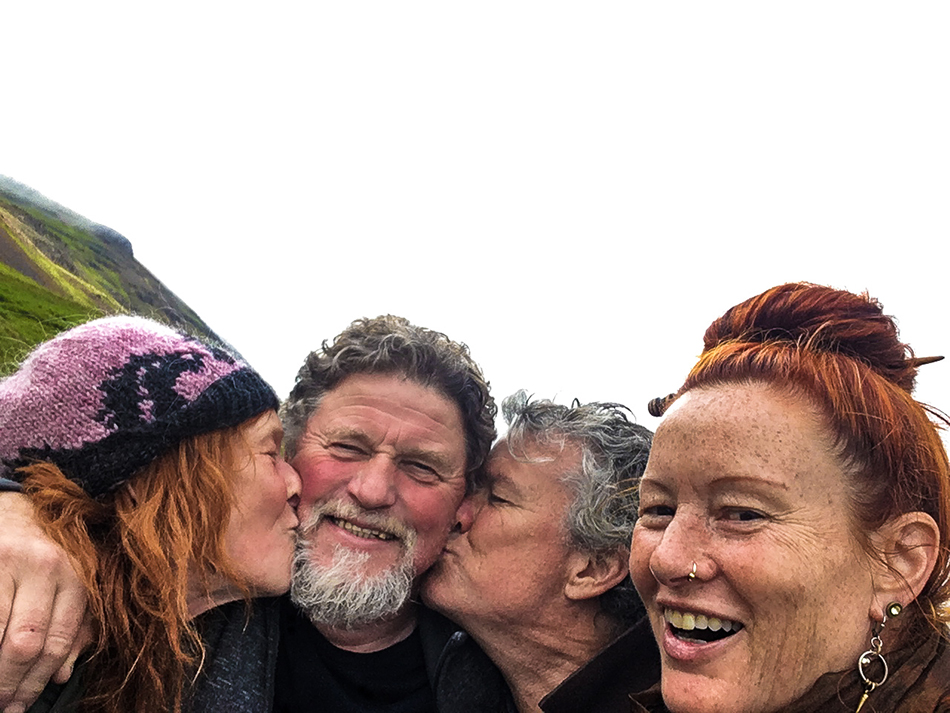
Colleen, Gudjon (God Man), gh, Lisa
Emotions were hijacked saying farewell when I realized how much I liked this guy I had only known for 36 hours or so (this kind of raid on trying to be cool is happening more and mo re). As we hugged goodbye, the heart cracked open a bit. Sure, the fracture was to allow admission of one more, but a break is a break and there is scar tissue now, the kind that occurs when you find and then have to leave a kindred spirit.
And God Man was not the only one. There was Helgi the filmmaker who stumbled across us in the north and followed us for a day. There was the Lord of the Manor of Trefacwyn, with whom we spent some magical days in Pembrokeshire, Wales. And there was the Old Caretaker of the Reykholt Hall who bonded with the band for a few hours as we set up, played, tore down and loaded out, embracing me warmly and then bowing to us all from the loading dock as we got into the van and, catching and holding my eye, tipping his hat to me before closing the loading dock doors. I wear no hat, so the best I could do was to blow him a kiss, which he smiled at and accepted as he disappeared. Another kindred spirit, another co-conspirator, another older song and dance man.
Broken by Stories
Elin’s Ger
This Mongolian ger was a long dreamed of thing of our host in Iceland, Elin. We spent a day there, our little band accompanied by Gudjon and a filmmaker from Sweden who had taken a shining to us at our concert the night before, and we cooked a meal, and walked the coast. As of this moment, the ger sits on land that is becoming the flash point in a long battle against foreign interests (Canadian lead) aiming to build a large scale hydro electric dam in the area. 270 square miles of affected area, the large scale flooding of vast lands, the end of three major rivers and hundreds of waterfalls, annihilating the flora and fauna that have been there since before memory, and changing the landscape in the way that only humans have had the hubris to do. As I write this, the engines of the big machines have just been fired up in the little village we left yesterday, the machinery preparing the road for bigger machinery to come, and some of the locals are weighing out the consequences of lying down in front of them.
The heart breaks.
Broken by Place
Beauty so bright, I took to wearing my sleeping maskwhile travelling.
At the most unsuspecting moments, the land itself steals away the breath along with any certainties of how beautiful “home” is. You’d have to have no pulse to be unmoved by the scenery offered up through the window of the van. The visual hits keep coming, again and again and again, until you start to feel exhausted by awe, the impulse to capture things on your phone finally numbed, and the van gets quiet because there are no more exclamations left in anyones’s belly, no more air in the lungs.
Such beauty can easily cause the heart to ache. And when the moment comes to turn away, to put all that beauty at your back to journey home, the heart breaks. Happened to us in Scotland, happened to us in Wales, happened to us in Iceland.
I will consider myself to be a very fortunate man indeed if my heart keeps breaking like this.
Ian Mackenzie—or “Two Tone” or “Sport Coat” or “ Two Fiddy” as I call him—shows us a little behind the scenes stuff and explains how he came to understand why he wanted to create a film that documented the Nights of Grief & Mystery. He was there as close to the beginning as a person with a camera could possibly have been.
Here’s what I learned in Árneshreppur this morning: the word “saunter” has its’ roots in the words “sanctity, sanity, sanitation (ie.respectful cleanliness)” and “terra”. In a nut shell, Holy Ground.
So, to saunter is to proceed as if one is walking on holy ground, taking time, watching where you step, altering the course when need be…walking WITH the place you are, not ON it. From a distance, this can look aimless. Not so.
It’s the more artful approach to any kind of getting from Point A to Point B…and takes into account the territory you are travelling through and the inhabitants of that territory…be that on land, in your thoughts, or in a performance.
Tonight in this village at North 66° 3’ 4.6002” West 21° 32’ 55.5864” we will be doing exactly that.










 Gregory Hoskins