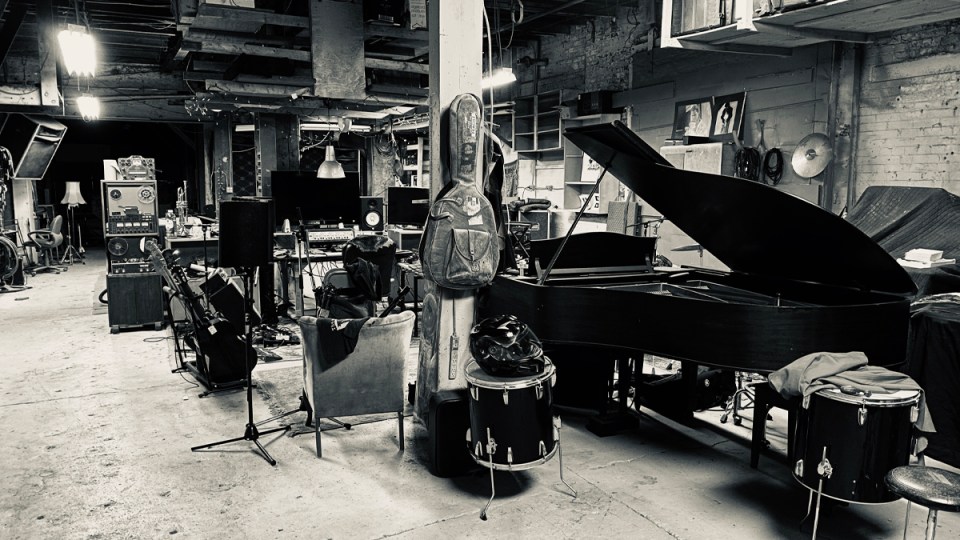
Dark Road Diary, Part 58: Fallow

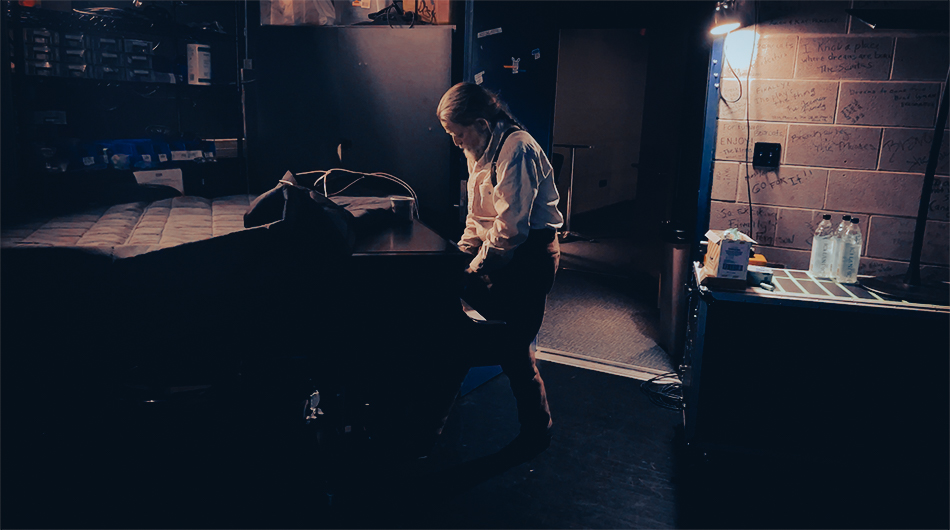
I’m at the door of a greenroom somewhere, in the midst of remembering the first gig of this tour six months earlier.

“It’s amazing,” I say, “to be on this side of all the Nights. Time surely passes.” 
I’m tucking the wires of my earbuds behind my ears while Jenkinson reaches behind his back to turn up the monitor pack clipped to his belt.
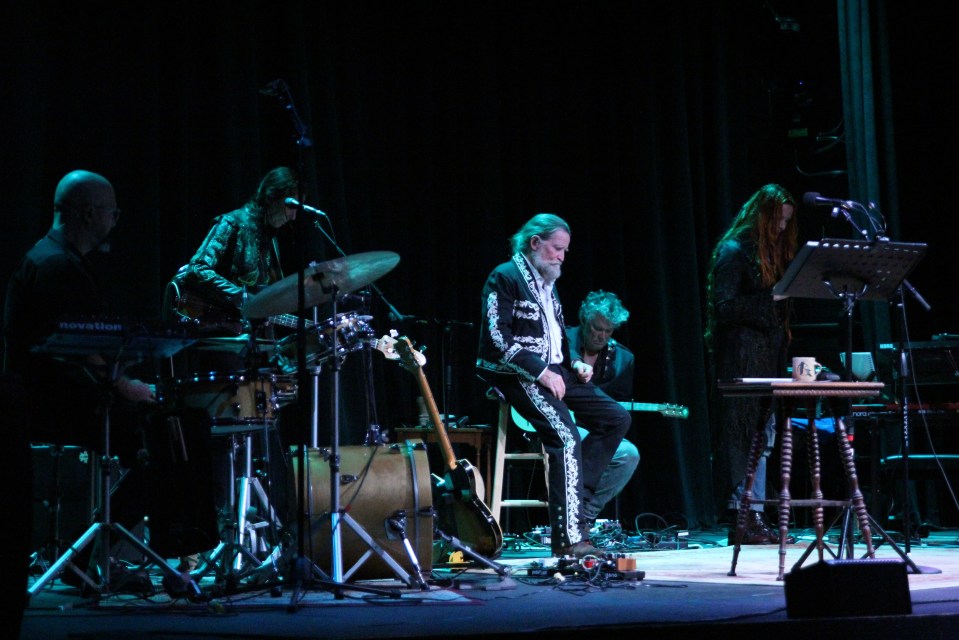
“Time IS passing,” he says, nudging my statement towards a clearing and bringing us into the moment. We walk out to the microphones.

There would be a couple more Nights, a few more strange beds, a few more airports, a few more rental counters, a bout of Covid on top of jet lag, then the final Night, and then…nothing. Or the illusion of nothing.

Aware of the extraordinary privilege of doing that we get to do for a couple hours behind the mics, we commit/submit to repetition—play/sleep/wake/travel/play/sleep/wake. Somewhere in the dullness of the repetition, the extraordinary becomes ordinary.  At face value, tour dates on a calendar come across innocent and above suspicion, even comforting, but they conceal consequences of the days in between and the months before, and the weeks after, riddled with details, pratfalls, pitfalls and immeasurable impact. Impact on the body, the planet, family, the helpers, the bank account, the nervous system…especially the nervous system, which can take only so many cycles of torquing and uncoiling before it becomes flayed, frayed, and played out.  So, somewhere along the sine wave of the doing and undoing of each Night we have quiet conversation, both of us on our bellies, commando crawling to the edge of ending. Or pausing. Or ending.

“It’s more like ‘fallow’,” I say. “You’re a farmer. You get it.”
He nods in agreement, but doesn’t say anything, letting the image be, I suppose:

a plowed field
muted hues of brown, gold, and grey
an act of will, denying the gratification of planting and harvesting in favour of recovery and regeneration.

The soil broken, but not not seeded.

gh
December 26, 2023, Guelph

Dark Road Diary, Part 55: Dark Road Lighter

When much of the day stacks up with things that ask to be complained about, the following can happen:

“This your conveyance?” asks a man leaving the Nevada City venue.

I have to think on the word a minute, but since I’m actually leaning on our rental car when he asks me, I put it together that he’s talking about what I’m leaning on. It’s long after the last note has died. Charlie and I are outside at the loading dock waiting on Stephen and Nathalie. We’ve been waiting what seems a long time.

“Uh, yeah,”  I say.
“Stay right here. Don’t leave yet. I’ve got something for ya,” he says.

He sprints up the rather steep hill that is the driveway to the venue and leaves me for a while to notice, among other things, that the stars are brighter than I thought they’d be in this part of the country. He returns, striding towards the car carrying a rag and shaking what I think is a can of spray paint. Then he’s spraying the windshield, a dense white cream covering the whole thing. 

It takes me a second to realize: he’s cleaning the glass. 

Spray, wipe, spray, wipe, throwing in the occasional exclamation in praise of microfibre cloths, along with a comment about how dirty the glass is.

Initially, I am…the word “aghast” comes to mind…but then I think— well, they do need cleaning in a bad way, the car came in crap condition from the rental company—  and I relax into letting him do his thing.  Still, something like embarrassment is dogging me (again) but I’m not sure if it’s my own embarrassment for driving a shitty car and I’m letting him do what I should have done, or for him doing what he’s doing. 

He goes vigorously at all the windows and the mirrors, suffers my repeated thank you’s, thanks me for the Night, and wishes us safe travels. Then he’s gone.

I don’t know what I expected when I got in the car after he left, but it was probably something like disappointment. I thought there’d be streaks, missed bits, and the evidence of good intentions, even though I just witnessed how hard he’d worked the rag.

The windows were near crystal clear. I could make out all the constellations as we drove the half-hour back to the motel.

His name was Evan, and on a day that was woefully short of goodwill in that town (the venue people…don’t get me started), Evan’s very humble kindness went a long way toward us recognizing/remembering the calibre of people that come see something called A Night of Grief and Mystery. Of course, no one expects that every one in attendance need do this kind of thing, but the actions of the one elevate the many. Or they can, anyway.

And we remember who we are playing for when we climb behind the mics.

gh
September 22, Auburn, California.

ReplyForward

Dark Road Diary, Part 54: Dark Road Darker

“The trouble with modernity is that you always find out by phone,” SJ says.
“That’s true,” I mumble, thinking of the reference to ‘daemon’ that he sites in The Gloss, the bringers of unwelcome news. 

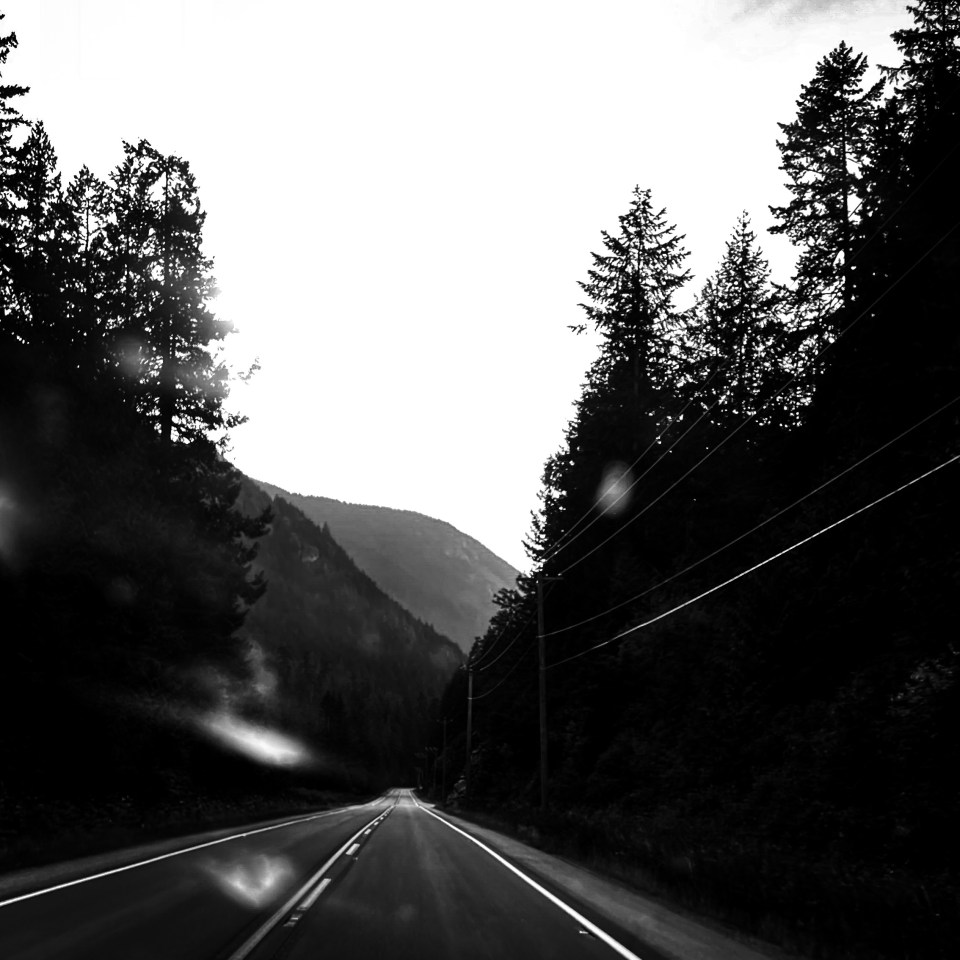
We are headed out of town, snaking along a road on the floor of a valley in a mountain range. He’s sitting in the co-pilot’s seat, though he’s admitted he’ll be no help with navigating using the touch screen mapping tech…or any vehicle tech, for that matter.

The news could be for/about any of us, about all manner of things, but he’s referring to a text I got in the middle of the night. My mother…93 years old…had a type of seizure, falling unconscious into the arms of my sister, sometime while we were sound checking. An emergency call, and ambulance, a battery of tests, the text I was reading listed all these things along with the predictable conclusion that no one could figure out what happened, more tests needed etc.

In the morning I tell my road mates I need a few minutes to make a call before hitting the road and I phone the house, speaking briefly with my mother. She does her best to be chipper, and I do my best to be a solid son until, nearing the end of the conversation, I can’t. The 59-year old solid son dissolves into liquid and I am a 6-year old boy clamping my lips tight, trying to stifle a wave of sobbing that is highjacking me. Since my father died, my mother and I have had this practice: every time we say goodbye in each other’s company, we mean it as the last goodbye. It seemed like a wise kind of practice.

There’s a long silence, the cell reception mangling the sounds of trucks passing on the roadway. I try to force some words out, try to apologize for the silence and my obvious state of emotions.
“I thought,” I stammer, “with all those goodbyes…I wouldn’t be undone,” I manage through clenched teeth.
“I know, I know,” she coos like a dove, reassuring me.  “One day at a time,” she says. It’s her go to phrase when the world seems like it is falling to pieces.

I end the call, the flood comes, and I am awash in sorrow (I am on the edge of it now as I type this) and embarrassment. I am in Nathalie’s arms in a parking lot. What is it about parking lots and tears on this tour?
I mutter to myself, “Get your shit together, get your shit together, get your shit together…for fuck sakes, get your shit together…”

I do get it together, eventually. I slap my sunglasses on and climb behind the wheel, a 6-year old piloting a tank of an SUV through the mountains.

“So, what do you think is happening?” SJ asks after a while. 
“She’s old,” I say, “That’s what’s happening.” I’m a little sharp.
“No,” he says, “I mean with you.”
A pause.
“I’m disappointed in myself. I thought I had a bead on this. All my time with you on the road, all the exposure…I thought I was solid…” I trail off.

“Did I ever tell you the one about tennis?” he asks.

He may have, I think to myself, but I retain less than you’d think after 8 years. “No,” I say. “I don’t think so”

He unspools a line of questions and as he talks I’m wondering what this has to do with anything, but am smart enough to shut up.
“So let’s say you like playing tennis.” 
“Yeah”
“Are you trying to get good at it?”
“Of course.”
“Why?”
“Because I love it.”
As best as I remember he says, “You don’t practice so you can finally stop doing what you love. You get close to the thing over and over again and, if you’re lucky, and if you’re paying attention, you get to chose: who you will be, how you will be, how you’ll proceed, how you will manage one foot in front of the other when the time comes. That’s what grief is. Life bends your knee…” he ends with, another line from The Gloss.

A few more tears gather and spill from behind my shades and I need to feel something other than the neoprene of the steering wheel under my hand. I reach for his hand and I find it. Smooth, a little gnarled and bony, not too far off from my own mother’s. My hand is there for a long moment or two and then back on to the steering wheel. I pack away a future sorrow and set my mind to keeping us safe on the long drive ahead.

It comes to this: You receive some news, you’re far away, and you get to find out a bit about who you really are. The Dark Road gets a little darker and then its one foot in front of the other.

One day at a time, as Mom would say.

Dark Road Diary, Part 53: The Chauffeur, The Nuthatch, and Me

“I was having a coffee and a cigarette one morning. You know…on the porch, feet up in front of me. A bird —a nuthatch, actually— landed on my boot,“ he says over his shoulder to me in the back seat, almost apologizing that he knows what kind of bird it is because he’s ‘into’ birds. 
“I watched the nuthatch try to bury a seed into my laces.”
“That’s beautiful,” I say to the back of his head. He’s in the driver’s seat, navigating thick traffic. It’s early morning, and we are enroute to the airport.

“Yeah…I mean, I don’t want to make it more than —you know— it is.”
“You don’t have to,” I say. “You don’t have to invent the beauty of it. Its’ all there”
He agrees. A little bolder now he says, “That, for me, is my way of being inside the temple.” 

I’m taken aback by his use of the image.

“That’s a genuinely mythical thing, a moment like that,” I say “and you chose to actually see it that way. Not everyone would. Plus, you chose to tell me the story. Now the beauty of that moment belongs to me, too.”

“Oh,” he says “I think anyone would recognize a moment like that.”

“Nah, man.  Maybe everyone could, but clearly not everyone does,” I say gazing out the car window at the 18 through lanes of highway pavement under our wheels and concrete everywhere else. “A moment like that can be a crucible…elementally transforming.”
“Crucible!” he proclaims. “I was just thinking of that word!”

We talk a bit more about books and the traffic, but mostly we let what’s left of the sunrise do the talking for us, and we arrive at the airport a little later. We pull the luggage out and pile it on a cart, and shake hands in a slightly rushed and awkward goodbye, the way strangers might after a sudden intimacy.

“See you again,” I say
“I do hope to meet you again,” he says.

Giving myself over to pushing the top-heavy cart through the airport I wonder, how do I find myself in conversations like this with complete strangers?

(75 minutes earlier)

“I used to live right here,” he says as we pass a little tract of row housing around the corner from where he picked me up. Sometimes I use a car service to get to the airport and this morning’s driver is a little older than me, a little taller than me, and speaks with a pronounced and proper English accent.

“Number 92…yeah. Thirty years ago now…” and then we’re past the place his DNA is all over.

“Is it weird?” I ask. “We just slip by a house you used to live in, no fanfare, no shouts of recognition or welcome back, the bricks and mortar not singing your name and slapping you on the back. It used to be home, now it isn’t. So…transient,” I finish, thinking of all the places I’ve lived. I guess I’m in a chatty mood.

“That word —transient—that really strikes me…” he says. “I’ve always felt like that.”

So it begins.

We haven’t been in the car 3 minutes and we are confessing to each other our life-long challenged sense of home, our divorce from land and place, speaking of it like it was a private, broken part of ourselves. An immigrant from South England, his parents had split when he was young and he and his brother were passed around here and there (a recipe for rootlessness if I ever heard one). He couldn’t wait to escape, and he did at quite a young age, only to be reunited with his brother years later in a small town in Canada. 

“My best, closest friend,” he said. “A talented artist, broke mostly, a real renaissance man.” 

As older men they travelled back to the Old Country and spent time wandering the South Downs , a protected wild area of chalk hills and sweeping fields he and his brother would escape to as youngsters to get away from the dullness of town and the mess of the home front. During the trip they took a photo of a landscape with a solitary windswept tree in it that the brother would later render as an oil painting. 
“He died 5 years after that trip. I took half his ashes back to the South Downs and buried them there at the foot of that tree.”

“I guess that’s home, then.” I say after a bit of quiet.

He speaks of wanting to belong somewhere, and we talk of the ‘longing’ part of that word. 
“I’m not an atheist, I’m not religious, either,” he says, and we agree that he’s simply uncomfortable with the rabid certainty of both camps.
And that’s when the nuthatch appears. 
And that is how the rest of the conversation appears. 

And that’s how this leg of the tour starts.

gh, 

Sept 12, Hinton, Alberta.

Dark Road Diary, Part 52: Nun

“I think I should be a nun,“ she says.

Unapologetic. Not a whiff of irony. Nathalie Roy lets those words tumble out of her mouth like pebbles from a hand.

She is the backbone of this operation, the midwife of it, the reason we are on the road now. She does a thousand things I can see and a thousand more that I don’t get to know about. In the van on the road, I do most of the driving, my eyes forward. But I can feel her over my right shoulder, occupying the rear passenger seat (Note: I’m not sure why, but everyone silently lays claim to their place in the seating arrangement in the van on the first day out and it never changes. Your place in the van becomes one of the few things you can count on, a small comfort maybe.) and she is hunched over her laptop, giving herself to the task of communicating with venues, hotels, insurance companies, people in the places we are headed to or have just been. I can hear her inhale and then exhale in a long breath, a bid to calm herself or ground herself in the face of doing a task she is good at, but not born to do.

“I missed my chance,“ she says. “I went away to Germany and when I returned my Mother said I was too old for the convent.”

“I didn’t peg you as the nun type, “ I say.

She shrugs. “I think I would have been a good nun.”

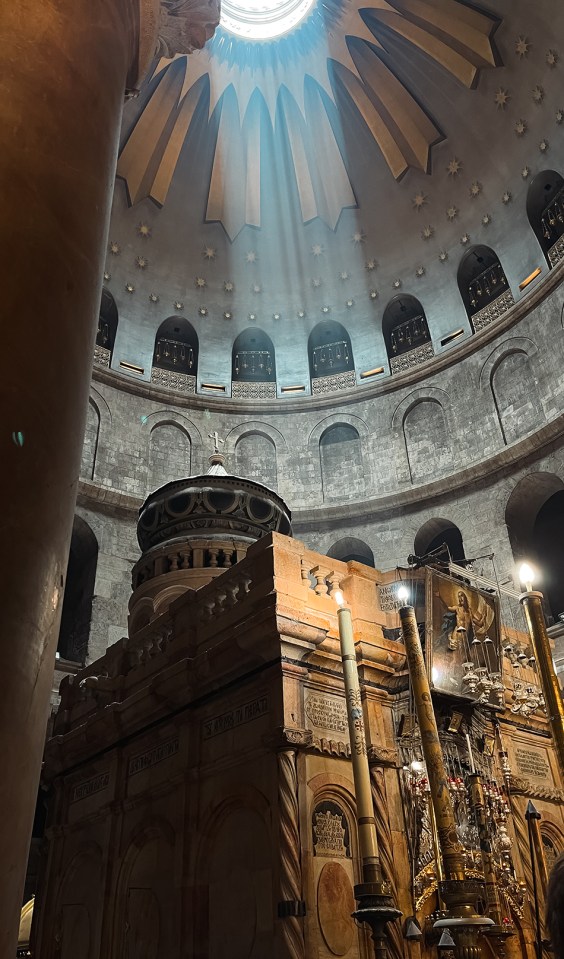
Then I remember a picture I took of her earlier this year in Old Jerusalem, deep underground in the tomb of Mary. Her clear capacity for devotion made me lift my phone to my eye.

Maybe this is what she means, that she has a strong sense of devotion and the understanding that such a devotion needs a home. For a while, that home has been the Nights of Grief and Mystery. She digs in at least as deep as Stephen and I do.

This tour is her love letter to the love letter that Jenkinson and I try to write every Night. And this is my love letter to her devotional act.

I thought you should know.

gh

Dark Road Diary, Part 49: Weather/Man

Sometimes the Dark Road is blessedly uneventful. A grind, but a predictable one. Other than a few bumps, the time on the Canadian East Coast was like the following: the grind to get where we were obliged to be, the grind of set up, the updraft of The Night, the grind of teardown and so on. There seems little to write about, but you know that’s not true.  What seems uneventful is actually a compacted series of high impact events and you just get used to that as “normal” or “even” or “uneventful”.

The Nights find me in the stratosphere and falling gently back to earth when I leave the stage. A strange and vulnerable state, there’s no bravado. I’m soft, I’m open…maybe a little too much. I run into a few folk still lingering outside the theatre doors. They try to tell me what they saw, they try to find the language, and I end up imploring, “Write it to me. If I could ask for 15 more minutes of your time, at some point in the next few days, write it to me. We could use a break from having to describe ourselves,” I say. 

There are promises made in the humid night and then I’m back on stage, on my knees, wrapping cable with Charlie.

The last thing I see when I am falling asleep in the motel a few hours later are the faces from earlier, looking like SJ and I just kicked in the door of their house. Not a violent act, but more like a storm wind might do. It’s a look of shock, sort of.
“You can be the weatherman, or you can be the weather,” SJ says to me our first morning in the UK. 
We’re talking about something else entirely, but he makes it sound like a permanent choice.
“Sometimes you’re one, sometimes you’re the other,” is what I end up thinking.

I think he and I are mostly the weather. I am, anyway.   

gh

Dark Road Diary, Part 48: Poor Charlie’s Ear

I find myself cracked open more this time out, a little more raw, more exposed, more volatile and more given to declarative absolutes (read: more opionionated) and we’re only three Nights in of 50 by the time we get to Santa Fe. It’s anyone’s guess what I’ll look like when we’re done this tour. 

I think this cracked open thing is self-made, a byproduct of a deal I made with myself to take more responsibility for the sonics, be as locked in as possible to the groove, to manage the electronics at my feet better, and to take creative risks every Night (trumpet!).  It might be that this contract is driven by the stirrings of the end of the Nights of Grief and Mystery, an ending that appeared the very first time we played eight years ago and has always been in sight but is closer now. At least, it gets talked about more in the quiet between Nights. Who knows what’ll happen. No one get’s to see beyond the edge. Not really.

So, how do you live an ending? One answer—the best answer—is go deeper, go wider, turn out the lights and get to know the thing again in the dark, renew your vow to it, let every bad memory of it take its’ rightful place beside all the exalted ones so both can lock step into the uncertain future. Start saying goodbye to the thing just as you say hello to all this new found land, and try not to be greedy with the moments you have left with it. There’s the chance to suffer a bit, too, in order to do the thing a little while longer.  

Charlie and I drive from Fort Worth to Santa Fe while Stephen and Nathalie fly to Albuquerque for a gig. It’s on this drive I start to taste the raw nerve endings. I talk poor Charlie’s ear off for most of the 9 hours. It’s not completely uninvited…I have a “no music in the van” policy that is law, so it’s either the tires singing or me talking. Charlie is great with shaping noise, but kind of lousy with silence, it seems, so he puts up with me. We are welcomed in Santa Fe, pour ourselves into the Night there, and then into the van the next day, the four of us, headed for Tucson.

Tucson welcomes us with drought, scorching heat, and then a monsoon chaser (an improbable repeat of five years ago when we got rained out of our outdoor venue and had to scramble to find somewhere to play). A few lightning bolts, downpours, and a power-outage later, we are at it again in front of a small but intrepid crowd.

“You’ve bat 2 right out of the park,” Jenkinson says to me afterwards in the greenroom.
“I told you, “ I said, “I’m trying really, really hard this time.”

Maybe that’s all this “cracked open” thing is: the result of trying really hard. All this inward consideration can feel selfish until I catch a few echoes from from the people who come and it’s confirmed: I’m just one of many for whom something happens in the 2-hours we are in front of the mics.

Onwards.

gh

Photo: Practicing trumpet in the motel parking lot, Tucson, Arizona, July 16, 2023.

Dark Road Diary, Part 47: The Thief With Lightning Fingers

I once stole a photo 
from a widow’s purse.

I was 15, and I was lonely…chronically.

The colour print was that of her daughter,
dressed in a white gown,
maybe at a wedding,
maybe at a convocation.

She was beautiful, and she was my age.
She is my age now.

Her father was a famous author,
and I’d had a sporadic letter-writing back and forth with him.
I met him when I was 12 or so.
He died at 60…just a year older than I am now.
There was a memorial for him in our city,
and this is how I found myself in a room near the widow’s purse.
With the room briefly empty and my breath held,
I lift the photo with lightning fingers and a bolt of guilt.

I taped the picture to my locker at school
and would let the door linger open between classes
in the hope that everyone would think I was claimed by someone.
That’s hope for you.

They lived in Fort Worth, Texas.
This is what I was thinking about, mostly, during our time there.

gh

Photo: On the road out of Fort Worth, Texas, July 13, 2023.

Dark Road Diary, Part 46: The Unimaginable Everything

We were, we determined, very different men 8 years ago when we were last in the Austin venue, the town’s first opera hall taken over by the Masons at some point. At the time, our appearance there was the second gig we had played together and we’ve since repeated the climb hundreds of times. It was sold out then, and it was sold out last night, too, thanks to Nathalie and those that put their hand up to bring us back. 

In the green room last night we were trying to find our way to the base of the mountain we had to build then climb. We’ve long since done away with any cocky fist pumping before we go out to the mics, and we’ve also learned not to be undone by nerves…the benefit, I guess, of the aforementioned doing this hundreds of times. But we also know there are no guarantees, so we have to know who we are before we start.  Sounds simple, but you know and I know that kind of knowing is elusive.

In the space of a few private minutes in the green room, we swam silently in the unimaginable everything that had happened to each of us in the last eight years—some of it good, some of it awful. Then the Older Us invited the Younger Us to come out to play because we had to admit: we admired their pluck, their willingness to court the unexpected, their capacity to say “I’m in” to a crazy idea with no possible chance of success.

It was a good move, I think. In the aftermath of the Night, there were so many people who tenderly stood in front of me with soft eyes locked on mine (a gesture I’ve learned to receive with more grace over these last 8 years) and gingerly found their way to not having any words (that tired compliment that can –at times– be such a cop out) and letting some other kind of gratitude fill the space.

The feeling was mutual.  Thank you Austin.  Would that we see you in another eight years.

gh

Photo: The stage at the Scottish Rite Theatre, Austin, Texas, July 11, 2023

Dark Road Diary: Old City, Jerusalem

So you find yourself alive, born to a particular time, in a particular place, and maybe into a particular tradition. The stories of that tradition weave themselves into your psyche, into the sinew of your world view, and you spend 40 years shadow boxing with something you feel you didn’t choose until you call a truce, make peace, and go back to your corners. You find yourself a further 20 years down the line, standing on ground zero of all that mythology because, chances are, the tradition you inherited didn’t come from the land you were born on, and you find yourself here, almost by accident.

Now, instead of fighting, you are dancing with the weight of it all, because at least you’ve learned that much—dancing with your opponent is more fruitful for the both of you. More graceful. More grace to be had. And you realize tradition is like a song that doesn’t end: you’ll be asked back to the dance floor, and you can accept or decline, and you can take a break if you get tired, and you can love or hate the song. It doesn’t care, and it won’t be offended. It will be the note under everything you do. You’ve come to a mutual understanding.

Because you are born in a particular time, a particular place, and maybe into a particular tradition.

gh

Image taken by the author: Golgotha, where, they say, was the site of many crucifixions, including Christ’s.

Dark Road Diary: Sine Wave

Tel Aviv, Israel.

It shouldn’t have worked.

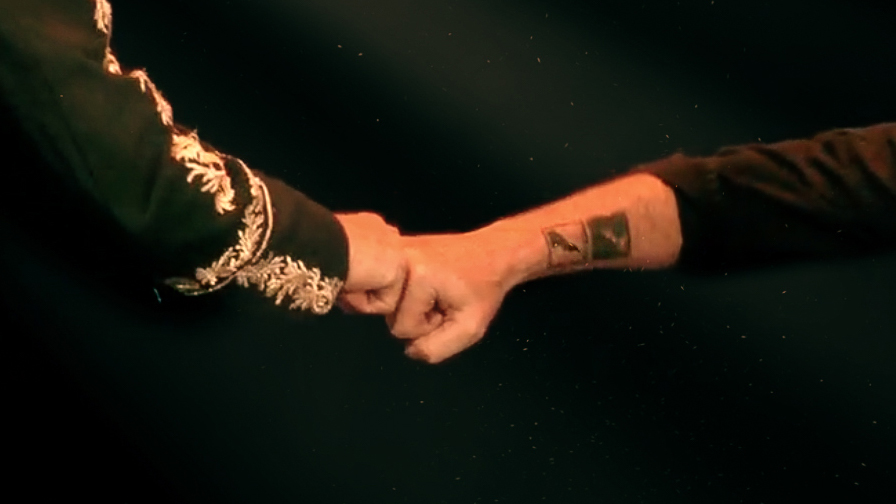
A last-minute venue change the day before the gig to a theatre situated in a movie cinema complex absolutely dressed up like a theme park, complete with life-size characters from the blockbusters of the last 40 years; an unfamiliar format for the evening that included an onstage interview with a prominent broadcaster, followed by a 45-minute set of a Night of Grief and Mystery— a window, open then shut; language barriers; jet lag; and the usual challenges that attend any live event production. Plus, we haven’t been on stage together in 7 months, so it was just a fist bump then “Go!”

It shouldn’t have worked, but it did.


My own understanding of what this thing is that I do with Jenkinson travels along a sine wave: I know what it is, then I don’t know what it is. I’m currently in the “I don’t know” phase. Strangely, it has a calming effect backstage. Fewer expectations, maybe. With room for only one song in the shortened set, we choose a brand new one I’ve never sung all the way through let alone in front of anyone. We decide to forgo a translator or have translated lyrics and text projected beside us, and so there is a gnawing, low-grade worry of not being understood—kind of like, “Is this mic on…?”


Afterwards: private, intimate, mostly silent exchanges with some who have stayed on; gestures in place of words, usually a hand to the heart; long moments of locking eyes; tender hand clasping, the kind that linger softly.

These things are enough for me to know it worked, whatever “it” is. Something worked. And that’s plenty enough to get me to the next gig in Tel Aviv in a few days’ time.

gh

Dark Road Diary, Part 41: Cincinnati, Ohio

The Tired is coming on, and it doubles down on us because The Cold is coming, too…the temperature kind, not the viral kind. It was a mercifully short-ish drive from Louisville and we are earlier than our load-in, so we kill time on the Main Street the theatre is on. Charlie finds a place to grab himself a bite, SJ and I find a sliver of sun to stand in. Not many words pass between us: we are likely both thinking of the next day’s mountain of swapping vans, picking up my car in Columbus, sending Charlie on his way home with gear we don’t need for the next leg, keeping gear that we do, and then beginning the drive clear across America.
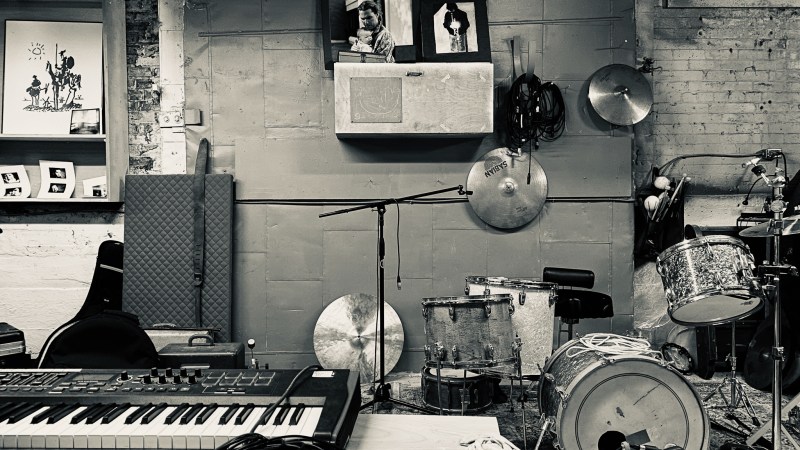
After the set up, we quietly ascend the stairs to a “not a room” green room…a part of a balcony that we can draw a drape on. The one wall is lined with a bank of padded benches. There is a bathroom that is ours, an that’s a small blessing. We deposit our bags and each take a place on a bench and silently let ourselves tip over. We don’t sleep, per se, but we invite it.

With no walls around us, we hear the doors open, the crowd start to gather, the murmuring grow. We assemble ourselves, walk down the back stairs to the stage door, our In Ears activated and the crowd noise amplified. We walk out on stage, bringing with us the silence that has kept us company most of the day, and we bring it out with us into the Night. We pour more than we have into the Night over the next two hours, keep up our end of the bargain. Afterwards, we hear a bit what it meant from some of the good-sized crowd that had attended.

Seized by hunger pangs that often appear after we’ve loaded out, we make way to a pizza joint a couple minutes away, the mood in the van in direct contrast to what it was eight hours earlier, until, that is, I realize with a panic that I’ve left my coat in the front row seating. We leave Charlie to wait for the pie, and I race back to the theatre, praying someone is still there. I throw flashers on, leave SJ in the van, pound on the door.

It’s opened by someone who is pulling on their jacket to leave. I explain I’d forgotten mine there, that I didn’t do an idiot check, and I retrieve it from the front row. I’m relieved.

“It’s a good thing. It’s getting cold,” the guy says.

“Yeah, true thing,” I say. “Everything’ll be fine now.”

Plus, there’s pizza. And a mountain after that.

gh

Dark Road Diary, Part 40: Louisville, Kentucky

She appears backstage, looking out of place in this big, brightly lit loading dock of the college-affiliated theatre we’ve just finished playing outside of Louisville, Kentucky.

She is old…a little older than old. She is tiny. Her hair is pure white. Her eyes are reddened. She is clutching a wine bottle, and she is looking around for somewhere to set it down or someone to give it to, so she comes off as a bit lost. Until she sees me, and sees me seeing her. We walk towards each other.

I look down at her, she looks up at me. I’m easily a foot and a half taller.

“You broke my heart,” she says, allowing a slight tremble in her throat and some new moisture to her eyes. “And it feels so good.”

I put my arms around her…all of her fits under my chin and she disappears into my chest. I hold her for a bit. She’s so small…like a bird: hollow-boned and nearly weightless.

I hold on a little too long, maybe…I miss my mother.

gh

Dark Road Diary, Part 38: Roanoke, Virginia

A week or so after playing in a beautifully kitted out theatre in Roanoke, for people eager to listen (most of whom had made the 1.5 hour journey down the mountain from Floyd), a note arrives to me by email.

It begins by saying they had attended the Night in Roanoke, had heard good things about the tour (“meaningful”; “soul stirring”), but were sadly disappointed. Deeply disappointed was the term used, actually. 

The root of the disappointment was the “dissonance of the drums and other guitar behaviour” given by members who seemed “more wrapped up in their performance than in giving meaning to process. It felt terribly disrespectful,” the note said. It concluded with describing emerging from the theatre “feeling scrambled and confused. I had no idea what message you were trying to convey,” and that other people in their party shared in the disappointment.

I read the note to Jenkinson while waiting for service at an interstate highway food joint.
“You going to respond?” he asks.
Pffftt…nah…no. I mean, no point, right?” I say.
“What would you say, though, if you did?” he asks me.

I try on a few weak and inelegant retorts and I am surprised to discover I’m actually a little hurt by the email, so my righteousness peters out, air out of a sad balloon. I’ve since let it roll around in me a bit, and here’s what I would have said at the diner counter, and maybe to the author of the note.

Dear Person,

  1. Most terms used to describe what we do are not ones that we would endorse. The Night has consequence, is what we would say…and it’s mostly a warning, not a description.
  2. Having expectations might be the best way to be disappointed.
  3. There’s no process on stage. There is a ton of listening, though.
  4. I can’t imagine a group of people more committed to getting out of the way than those who travel with me.
  5. I can’t imagine a guitarist more disinclined to “perform” than yours truly.
  6. I can’t imagine a singer/guitarist who has more respect for those who would leave their home on any given evening and put their hard earned money on something called a Night of Grief and Mystery.
  7. Scrambled and confused seems pretty much a spot-on way to feel after A Night of Grief and Mystery.
  8. We have no message to convey, so you can feel ok about not understanding what wasn’t there.

Respectfully, The Guitarist

gh

Dark Road Diary, Part 37: Washington, DC

About a mile and a half up from the Whitehouse, Harvard Street is lined with formidable old churches, temples, lodges…this particular territory staked out by the religiously inclined about the same time they were painting the house down the street white. These things look like they were laser carved out of granite. And there are columns…lots of columns. Nothing says “I’m dead serious” like granite columns. It is in one of these buildings that we put on a Night.

The band hasn’t joined us in a month, and they are on the back end of a 9-hour drive down from Toronto, so the proceedings are a little rough around the edges which, honestly, is how I prefer it.

I look around occasionally, wondering what the people are making of what we do. We are strangers in a strange town. They are strangers in a strange town. We have that in common: this is a strange town.

Here’s what I recall of the ending of the night: I slide the guitar strap over my head and off my shoulder, turning my back to the crowd while I put the guitar down, and when I turn back around, Jenkinson has lunged past his mic, heading into the outstretched arms of an older Black woman in the front row.

“What was that all about?” I ask later on.
“She was giving me face all night long!” he says. “It just had to be done.”

As we pack up, there is a regular flow of interruptions, people who want to respond to what they just took part in. I’ve learned to lead people past “I can’t really find the words…” with this simple directive: “Try,” I say.

I come to realize that in Washington, DC, we have brought something that makes no promises, breaks no promises, has no end game, no design to alleviate, no design to punish; no design to sell; we do something that draws on no book, no constitution, but on the work of living and the work of ending.

We have no agenda in a town dripping with agenda, drooling with agenda, drowning in agenda. That’s what people were trying to say, I think.

gh

Photo by Drake Sorey

Dark Road Diary, Part 36: Massey Hall

What happens when you finally get to do something you’ve long wanted to do?

A few weeks ago, somewhere in coastal Washington State, I received an email from Canadian singer-songwriter Hayden asking me if I’d like to sing a song with the Art of Time Ensemble at a benefit concert called Dream Serenade. The concert — held annually for almost 15 years — was returning to Massey Hall. That’s the Carnegie Hall of Canada. It’s also a place I’ve never sang in. Always wanted to, never been asked. Until the email from Hayden.

Schedules rejigged (it turns out the date fell on a day we were on tour but it was a travel day, making it possible for me to get to Toronto, do the gig, turn around and rejoin the tour in Washington), I get to the newly renovated Citadel of Dreams. On the backstage walls are beautiful photographs of a Who’s Who of the western music world playing on the stage. This is the allure of the hall: the people who have played here before you. This might also be the reason to get very nervous.

It was only one song. It wasn’t even my song. Officially, I will never say I’ve “done” Massey Hall. I will say, “I’ve sung in Massey Hall.” 

In the minutes leading up to my tune I had the worst dry mouth I’ve ever had that mercifully relinquished its’ grip on me 30 seconds before walking out onto stage. I was fatefully introduced as one of the other singers on the bill (admittedly, a 4-hour concert is a tough gig for any pair of MC’s to navigate) so my first official words on that stage were “My name is Sarah Slean.”

It’s not for me to say how well I did or didn’t do. I can tell you this, though: as I moved off the mic after my last note, that’s when I really realized I was in Massey Hall, and I commanded my brain to drink in the last nanoseconds of my voice ringing off the walls, the sound of the audience’s response, to tattoo the memory somewhere deep inside me, like you might do when having a last swim in a warm lake in the late, late summer, knowing it will seem like forever until you get to feel it like this again. Or, maybe, you never get to feel it again.

No guarantees: the great equalizer.

I sleep a couple hours at my daughters’ in Toronto, have an airport limo take me to Pearson International at 5:30 am (it was a full on Escalade, tinted windows and the whole nine yards. I felt like Drake). Took my seat in Business Class, which for some reason was cheaper for me to book with points than Economy, got picked up in DC, and was at the venue two hours before the rest of the band and 12 hours after I’d been singing in Massey Hall.

Jenkinson asks, “So? Worth it?”

I pause. I don’t know what to say.

“It’s that thing about doing something you’ve always wanted to do. What do you do with the done-ness of it? The other side of the imaginary mountain?”

Thank you, Hayden, for the chance for me to find out.

gh

Dark Road Diary, Part 35: The Stranger Silence Between


Why do we say silence ‘falls’,
like it’s some kind of cloud lurking in the rafters just waiting to descend uninvited,
when it is The Host that welcomes us in to an empty space in the first place,
there before we arrive and there after we leave?


A man walks alone, from pool of light to pool of light along the walkway that hugs the theatre on Vashon Island, WA. He is tall and thin, older and masked up, and he spots me lingering in the shadows of the recycling bins trying to quell post-gig anxiety that can pop up now and then. Jenkinson is signing books, and I’ve changed into my ratty road uniform of jeans, scarf, and coat, hoping the night air helps to ground me. Having deduced I was one of the two men on stage, he quietly thanks me for the evening and I acknowledge him with a small smile and a head nod. He stops, and with a demeanour that asks If you don’t mind…? he turns to step into the shadow with me. With a gesture of my own that says Not at all, I take a step forward and meet him in the penumbra. (Penumbra: the area between shadow and light…I had to look that up. Ed)

Quiet and well spoken, he tells me he hesitates to characterize the evening at the risk of over simplifying. I watch him finger his way along the beads of possible words, landing at profound, but he’s not quite satisfied with it.
Then he looks puzzled, a bit pained, almost apologetic.
“I didn’t know what to do between pieces. No one did, it seems,” he says.

I smile. He’s referring to the silence that can fall over a room when we finish a poem or song. It differs from night to night, depending on the Crowd Mind, but it is almost always there in some fashion. “That’s ok. I had to learn over the years what those intervals could mean and occasionally I need to relearn it.”
He lowers his mask beneath his nose. 
“It didn’t seem right to clap—and it was uncomfortable not to—but it was something like reverence there after a poem or song, and applauding would have broken it. It was confusing.”
“Yeah. It can be that way” I say. “The quiet can detonate certainty. Applause can be easy, seductive, maybe even addictive…on both sides of the microphone. Silence takes work.”

He pulls his mask all the way down now. “And it would feel too much like theatre. This was definitely not theatre.” 
That distinction, unprompted, surprises me. 
“Definitely not theatre,” I agree. “Matter of fact, when we talk about this—and we talk about it a lot—that is at the very top of the ‘What We Know This Is NOT’ list.” (Performance, show, entertainment, distraction, concert, and genre specific would be next…the list of what we know it’s not is longer than the list of what we know it is. Ed)
“Plus,” I add, “audiences are deeply trained organisms, and the training is useless on a Night like this.”

The gentleman makes a couple charitable comparisons to Cohen and hunts for a few more summary adjectives before the attempt dissolves into the mysteries and we shake hands, parting ways, wishing each other safe travels on the dark roads of this little island in the Pacific. It’s a completely moonless night.

I know that in a few minutes, after the book signing is done, SJ and I will convene in the greenroom, and we’ll dissect the silence that was with us on stage, and I’ll be able to tell him about the conversation I had in the shadows, one more marker on the map of a night of grief and mystery, should we feel a bit lost in the quiet.

gh

Dark Road Diary, Part 34: I Close My Eyes

I close my eyes when I sing. I always have.

As far as I can tell, it’s not to exclude the watching crowd, or the band with me on stage. It’s to include the words.

I get distracted easily, interpreting people’s postures and facial expressions, and a full-on conversation starts in my head while I’m trying to wring whatever I can from the words and the silences between them.

At a show in Denver, I’m packing my gear and an elderly woman approaches the stage in the now empty theatre. In a clear Irish lilt (she’s from the Old Country), she lets me know how thankful she was for the Night, and her impressions of my voice and songs.

“You can sing,” she says.

“I try, “ I say, and feel compelled to apologize for closing my eyes all the time, explaining that I’m afraid I’ll lose my way, the connection to the words being fragile sometimes.

“Ach…nonsense, “ she says, “they’re your words! You need to do what you need to do to get them out.”

“And there is no guarantee in the moment that I know how to do that,” I say, expecting her to not understand.

But she does. Turns out she has spent her life in the theatre, and she tells me the story of Sir Laurence Olivier disappearing after a performance of Lear one night, despite the audience screaming for a curtain call. He’s found cowering in a corner by the director who asks why he is hiding and tells him it was the most sublime performance he’d ever seen. Larry says, “I know! But I don’t know how I did it!”

We agreed closing eyes on stage in an attempt to get somewhere you’ve never been is worth the possible misconception that you are somehow “apart” from the crowd.

“There was a song you did in particular…about the arrow…knocked my knickers off!” she said as she turned to leave.

I decided to keep closing my eyes.

Dark Road Diary, Part 33: John of the Laundromat

John of The Laundromat

It’s hard to know what an audience at A Night is thinking…or feeling. For one, they aren’t really an audience, they’re unintentional allies in a ceremony. They don’t seem to know it, but we do. Beyond the applause and standing O’s, there is the ever foggy sense of “are they with us?” as we spin the kind of glass that we do. No suspension of disbelief is required for this kind of evening. The deal we are trying to make with them is a different one altogether. If there is good will in the building, we can generally pick up on it, but it’s not always clear.

The morning after the Moab Night in front of a full house – which was a free event sponsored by a local hospice organization – I’m doing laundry in the local laundromat. As I finish emptying the dryer, I turn to find an older gentleman a foot away, staring at me.

“I saw you last night,” he says. “It was a wonderful event. I have a few questions for you, if you have the time.”

Always an iffy proposition, and more SJ’s territory than mine, but I’m curious so I figure, what the hell.

“Sure.”

He asks about why we don’t have an intermission, about the set list, a couple other things, and I do my best to answer as I fold my laundry.

Then he asks, “What did you think of the audience?”

That was a stumper. Besides the cell phones going off despite the plea to have them silenced and the full-blown conversation from a deep-voiced individual during the first 10 minutes (dealt with A LOT more grace by SJ than I am capable of), there was the ever present aforementioned foggy sense of just whose side they were on.

I relay this as best as I can, he listens thoughtfully, and almost like a plea he says, “I thought they were with you the whole night, attentive and completely riveted.”

Huh. “Well, I’m glad to hear that,” I manage. He gives me a few tips on what to see around the area before I leave for Colorado (which I took him up on…thanks, John), we say our polite goodbyes and I head out the door into the Moab heat with my folded laundry. 

If you ever find yourself walking a tight rope in front of a crowd that no one has asked you to walk, go to a laundromat the next morning. You might find out how you did. No matter what you thought at the time.

gh
Sept 19, 2022, Boulder, Colorado.

Dark Road Diary, Part 31: Older

I am 53 years old.

Somewhere on the Australian coast in 2017, SJ and I sit watching a group of young people cavorting on the beach we share. I look down at my bloated self and complain about the passage of time, yearning for the form and function of youth.

“That shit is gone,” SJ says, “and it ain’t coming back.” Spoken like a man who knows.

I am 56 years old.

During a 60 Second Answer session I remind SJ of the beach, of the gone-ness of youth.

“What takes its’ place, then?” I ask.

“If you’re lucky, nothing at all,” he tells me. “If you work your ass off, nothing takes its place. It’s a BIG thing in life: Going, going, gone…but not everything goes at once, so you’ve no obligation to scramble to try to reassemble all the parts you started with. You’ve got fewer, you’re lucky. It’s less to carry around. The room for manoeuvering increases the less you’re bound to of the stuff you used to understand yourself to be.”

I am 58 years old.

Every night on stage on this tour is a chance for me to be fully that age, but it’s not granted as a guarantee. Often, the first notes I play are like a key that unlocks the door behind which is every self-immolating thought, every failure I’ve stored away during the run up to the gig, and they pour through. And there I am, taking a public shower under a torrent of insecurity. It’s a precarious moment, and one would think, at my age and with as much time in as I’ve had in the scenario, I’d have a sure fire way of handling it. 

I don’t. I throw myself on the mercy of the moment. Hardly a sure fire way of doing anything, a kind of reactivity of a 15 year old.

We talk about this on the drive from Salt Lake City to Moab, Utah, where we will play tonight. As we talk, the landscape starts to be accompanied by the red sandstone monoliths the area is renowned for. Older is in the truck with me, and older is surrounding me outside.

Would that I have all I need to remind me to manoeuvre tonight.

gh

Darr Road Diary, Part 32: Plugged Out

The first thing we do after walking on to stage is plug into our in-ears monitors. The price of being able to hear ourselves in glorious clarity is not being able to hear the gathered crowd, or us talking to each other off-mic. By plugging into the system, we unplug from the world. The irony is not lost.

“Blame Bowman,” SJ says.  It’s true…it’s all drummer Adam Bowman’s fault. It was a sure fire way to make the stage experience more musical for us, he said. It cut way down on sound check time, and it meant we didn’t have to carry expensive and heavy wedges around. All true and we are grateful for his expertise.

But the isolation is utterly complete. It’s a weird first move to make on stage. And, as with any added bit of tech, it’s another thing that can go awry, as happened in Boise. Stephen’s in-ears feed completely disappeared somewhere between soundcheck and the downbeat of the Night.

“I’ve got nothing…” Stephen managed to tell me. Under the gaze of the watching crowd, I tried twisting a few virtual knobs and buttons, still nothing. Unable to fix the problem, I basically threw him under the bus. 

“Looks like you’re going old, old school, man,” I said on mic.

And he did, the whole Night long. He rose…he more than rose…to the challenge. As one person wrote in the next day, “Tears filled my eyes many times and overflowed …such an enlightening and soul touching evening…”

Ah, adversity: the faithful companion of every Night.

gh

Photo Credit:

Dark Road Diary, Part 30: “If my car was clean, I could come and get you.”

What kind of a world is it when… is a phrase often invoked in the face of a once-and-supposed good thing gone bad, the corruption of a formally (seemingly) innocent act, a kindness that gets dissected to see what cancer really lays beneath, or a eulogy for choices once easy now hamstrung by doubt.

Waiting out a layover in Chicago’s O’Hare airport en route to Boise, Idaho, I thought it’d prudent to call ahead to the hotel to let them know we’d be checking in late. The conversation with Jane the Hotel Clerk was standard front desk fare, but it veered suddenly when I inquired about an airport shuttle and was informed the hotel had none.

“If my car was clean, I could come and get you,” says the young voice on the other end of the line. I stumble a bit and asked her to repeat, stammering that it was a kind offer but way out of the line of duty “and, anyway, we are musicians with a lot of gear.”

“We’ll work it out,” she says and I find myself on the receiving end of a plan that includes a shift ending, a car cleaning, a co-worker, a plea not to tell anybody about the offer, and an exchange of cell numbers.

Should I have been so thrown? It was a small-town kindness, but is Boise a small town? Is it kind? One stranger offers another stranger a ride—there’s  something glorious there, and some shadowy thing right behind the glory. Optics, optics, optics is all I can think about. That and, this young woman shouldn’t be offering strange men a lift anywhere these days. “Let me talk this over with my partner,” I say, and beneath our masks Stephen and I whisper back-and-forth.

Let’s just say it: nobody knows the rules anymore.

“Could be a good caper,” SJ says.
“Could be a trap,” I say.
“Could be the Gods offering a little help in the face of adversity,” he says.
“Could be a trap,” I say.

What kind of world is it when you have to second-guess every surprising thing that floats your way? The answer: a world that demands you make the right choice – every time – and sometimes you have to choose for everyone.

In the end gently refused the offer, and in order to say ‘sorry’ and ‘thanks’ in the same move, I let her know that we would set aside a couple of tickets in her name at the door to this thing we’ve come to town to do, something called A Night of Grief & Mystery.
“Google it,” I texted.
“OMG… tysm!” she texted back. 

It took me a few seconds to figure out what the jumble of letters meant and I signed off as any good father would:
“Make good choices, Jane.”

gh
Boise, Idaho, Sept. 13, 2:00am

Dark Road Diary, Part 29: Gig Mechanics

Waiting side stage, Smock Alley Theatre, Dublin, Ireland. Photo: Adam Bowman

The arrow doesn’t know
The target or the bow
It’s born in air
Dangerously unaware.

It flies a faithful arc
Through skies light and dark
No promise it finds its’ mark
But it flies anyway.

From “Arrow” ©2022, Gregory Hoskins

Let’s say you have a good notion of what you’re supposed to be doing with your life — some use the term “a calling”, I don’t — and let’s say that you’re lucky enough to have been supported in a myriad of mysterious ways to do that thing. Fine. Now let’s say that because it has the thumbprint of a certain kind of meant-to-be-ness, you find yourself with one foot in the ethereal world of assignment and the other in the more recognizable grind of keeping up your end of the day-to-day deal: a collection indescribable tasks I’ve come to call the Gig Mechanics, the tending to the invisible parts of the machine that allows the Gig to exist.

How you relate to the Gig Mechanics is a choice, somewhat based on your natural inclinations towards detail. Personally, I see it as a dance. Thing is, I’m not a very good dancer. I often end up looking like someone in a dance marathon who has hung in to the bitter end, like a barely-there shell of a person, a ghost leaning on an unfortunate partner. It isn’t pretty.

Get close to someone who is in the thick and thrall of such an endeavour and you are certain to see someone with all the beauty scrubbed away, all the elegance, grace, and assuredness so readily seen from a distance now burned or bleached off of them. Recently, I passed through UK Customs in Heathrow and caught a glimpse of myself in the photo that is snapped as you pass through an e-gate. It was shocking. I looked like I’d been dragged behind the plane across the Atlantic, the toll of the pandemic years’ worth of record making and film making and finally prepping for our tour in the UK and Ireland as the world lurched awkwardly out of plague mode resulting in a mountain of worrying and second-guessing every plan…all of it in plain view in that official photo. I’m not complaining (as my friend SJ says) I’m remembering.

But it was a rewarding tour, by most accounts. No one got Covid; the response from the intrepid folk who helped and /or attended confirmed that there is still a place for something called a Night of Grief & Mystery; and we sold out 8 of our 10 Nights. Mind you, we did those 10 Nights in 11 days, thus this post you are reading. Here are a few things I learned:

  1. 10 gigs in 11 nights isn’t heroic or quixotic. It’s stupid.
  2. Booking a venue based on a picture from the internet is playing sonic russian roulette.
  3. You can lean on people, but lean too hard and they will understandably crack.
  4. Weather systems in a van are like those on the coast: they change every five minutes.
  5. Eating a burger in a gas station parking lot after midnight can be a life affirming thing.
  6. While the previous statement is true, having nutritious food at the gig would be nothing less than an act of love. I seem to have forgotten this.
  7. Sometimes you need to remind yourself that you are part of a ceremony, not a concert performance.
  8. It could be that The Hands that guide these things occasionally see your blind spots and provide a Justin Bonnet (road wrangler) or a Charlie Scaife (sound man) to help smooth the way.

To the band – Lisa Hodgson, Colleen Hodgson, Adam Bowman – and to my compañero SJ, a thousand apologies for the pace, a deep bow for being unwitting but willing partners in the awkward dance with the Gig Mechanics, and a thousand thanks for the glimpse into the possibilities. 

This could be good.

gh

Transubstantiate

It’s possible, I suppose, that a song can be about something, but the song doesn’t have to be that thing. This song, for instance, Take a Little Walk: It’s a song about a lifelong fear of the dark, about a night I spent in the woods behind our farm in an attempt to quell that fear when I was about 30. It made it onto a recording called Surgery in 1996 and then it sort of refused to be performed until it began a concert broadcast/recording I did for the CBC in 2007 called Pleasure & Relief: A Live Concert Recording, this version with a string arrangement. Eight years later, Stephen Jenkinson reluctantly peeled the cellophane from a copy of that recording, put the disc in a crappy boom box, pressed play, heard the string prelude, then the song. All the Songs of Love is an account of what happened for him next.

The first tour we did together in 2015 was to be our last. We had no designs on a long-term thing, and he said as much from every stage as we went along. An old theatre in Austin, Texas, is the first time he performed All The Songs of Love, though that’s not what he called it. It came out of his mouth as he was introducing me midway through the night, and it completely caught me off guard. Maybe him, too. On that old stage my song took on a new life, transubstantiated into a meditation on dying, leaving only the appearances of the original song intact.

The song for me now is both these things: my account of taking 
…a little walk through them fields
Gonna carry me gently for my heart to heal

Gonna find me a demon in a dark, dark wood
You can’t come with me, though I wish you could.

and Stephen’s poetic response to that chorus, which to him was
the sound of how, 
on bended knee, with knitted brow, 
you can approach that little pile of regrets that mark you,
the altar of stones which is the ending of days.

Onwards,

gh

From the film Dead Starling Session. A still from All the Songs of Love. That’s Adam Bowman on drums, Colleen Hodgson on bass. Not pictured here is Lisa Hodgson on keys and vocals.

The Dark Road Diary, Part 28: 60 Seconds to Come Undone


As it happens from time to time, we head down a path towards something we are certain of only to arrive uncertain of who we are, where we landed, and why we left our locked-down inevitability in the first place. This is the 60 Second Answers to me. 

The whole thing was my idea, meant to be quick, artful, honest, and immediate— just SJ and I in the stale air of Dead Starling studio. On the cusp of releasing two new recordings, it was a creative response making peace with the internet’s demand for content (a reality if you set up shop on the thing). It was part potshot at the short attention span of internet culture and part experiment to see what would happen if we clamped a ridiculous time limit on addressing big questions of a personal nature. And privately, it was going to be a place I could flex a new-found/hard-won conviction that I “knew a thing or two”, the byproduct of a truce with my otherwise unmoored mind while I was mixing DARK ROADS and ROUGH GODS in the late summer.

It backfired. It became painfully obvious—even as the first round of questions were being shot— that I was not who I thought I was, not capable of what I thought I was, didn’t know what I thought I knew. I wasn’t prepared for the storm in the eye of the question, and the videos are a record of a man slowly coming to terms with a panic that obliterates. The other man in the videos –SJ– has the unenviable task of repeatedly watching that sun come up on the man, the dawning of understanding “there are a lot of things we are not going to get to be”.

At 56 years old, I’m coming to recognize the consequence of knowing and the despair of not knowing. This is a weighty thing in a time where that despair can easily become a wildfire. The fuel is uninhibited access to that kind of ‘information’ that is mostly opinion, parading as fact. Neither of those is a story. And that’s what we’re yearning for, I think: stories. Not certainties. And they’re in short supply. Right now the story includes me developing the skill of being gracefully uncertain of things, making friends with NOT knowing.

There’s the storm in the eye of the question. And it might be that NOT knowing is the calm in the eye of that storm.

gh


The Dark Road Diary, Part 27: A Few Of My Favourite (Coveted) Things


Welcome to that plea for all your unsuspected kin,
Travelling that lost nation road even now.
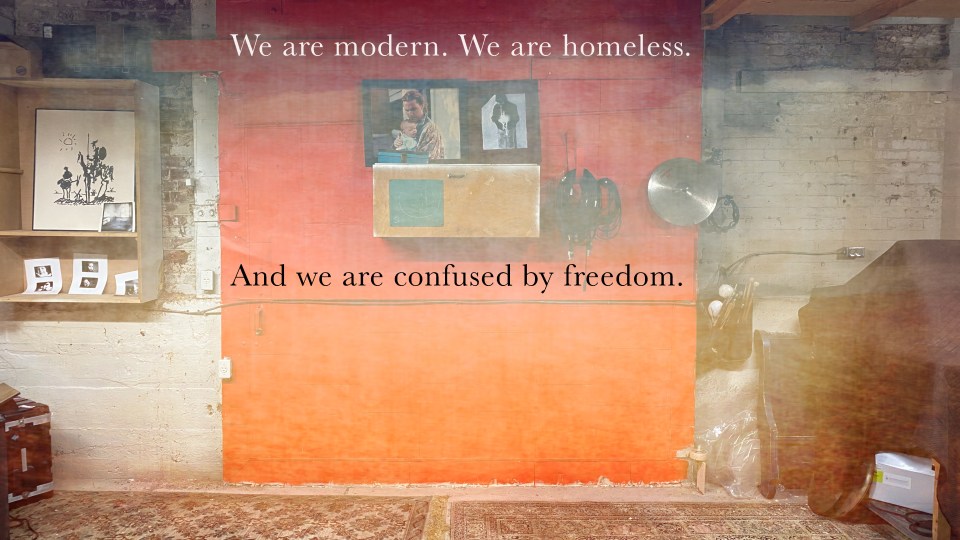
We are modern, we are homeless, and we are confused by freedom.
And so we’ve left them to themselves, or to each other, or to their god,
As we ourselves seem now to have been left.*

*From Invocation, by Stephen Jenkinson, from ROUGH GODS

Lisa Hodgson and Stephen Jenkinson, Dead Starling Studio, August, 2020.

You know the cliche: the songwriter hears a great line and mutters to no one, “Damn…wish I’d written that.”  It’s a private moment, not a proud one. There aren’t many words or lyrics that I’ve wished I’ve written, not because there haven’t been a great many lines I wish I’d written (there have!), but because I understood early on that it was a waste of a good wish. Instead, I figured out how to get inspired….try to locate something in my own learning that gave me the same response as the thing I coveted…or at least aim at it.

We are modern, we are homeless, and we are confused by freedom is one of those coveted lines. I wish it was mine. I really do. It’s perceptive, elegant, simple, dead true, heartbreaking and comforting all at the same time. It’s a keen summation of the current world. The line explains a lot about why things are the way they are but doesn’t have to explain itself. It promises no change, offers no hope, is not yet another call to yet another toothless revolution. It’s a scathing indictment and as gentle and non-judgmental as a thing could be. On stage, making things up as we went along, I came to always wrap that line in something different from the rest of the Invocation. It became something we aimed at, that line did. A gathering point, and a turning point.

I’ve been absolutely wary of trying to turn any of SJ’s stuff into a song. The alchemy of “prose into song” is dangerous and there isn’t a word that has been written that can withstand any mishandling. When we decided to make an “echo” version of the Invocation for ROUGH GODS, we began with the idea of having it read by another voice. We tried me reading it, and I was awful. Then came the notion of having it intoned, and then, finally, sung. We first settled on Lisa reading and then the question: what if she sang it? I was resistant to the whole notion, but applied myself to the situation.

Wariness aside, I’d long privately thought that were I to try turn some of SJ’s text into song, I would aim at My Favourite Coveted Line so, naturally, it was the first thing to emerge as promising. Through twists and turns in different arrangements, it became what you hear …an R&B inflected lament to the way things are. All the other melodies that came to be for the other sections of The Exegesis owe their existence to the fact that this section made itself known to be worthy of the rest of the effort. Recording is rarely easy, in my experience, and Lisa and I had to try a few different approaches to the singing of all the sections in The Exegesis over the months, with Stephen chiming in from afar. When she sang this verse, though, we all knew it had found itself and no tinkering was needed, and the challenge became having everything else sound as at home with itself. I think we found our way through pretty well.

Having the coveted thing is rarely as satisfying as the coveting would promise. Be it a lyric, a haircut, a cool brown leather jacket from Germany that your producer was given by someone famous, or (and this is important) knowledge or wisdom from someone who maybe has seen more life than you: something earned is better. It will take you further and will be more valuable to those to whom you will eventually leave it. But the coveted thing might be something to aim at, a clue as to where to rummage around in your own life for something you’ve missed noticing. Careful, though: might not be what you expected. Or wanted. Or wished for. Another classic cliche.


Listen to an excerpt from Exegesis, a couple of the sections leading up to the Coveted Line.

The Dark Road Diary: Part 26


COME THE ROMANS, COME THE WEST.

Listen to Come The Romans now. Recorded live in Los Angeles, Nov 21, 2019.

We sat on the side of the road somewhere in a car, me making an ineloquent case for turning a massive chunk of writing into a morsel for NOGM, him politely listening.

My case was this: Part of my dismay at living in the modern world stems from not having a relationship to the story of how things got to be this way. We act like a people that knows something is wrong, but we can’t quite put our finger on it, and we’d rather not see what lurks behind the myth we’ve created of “us”, a myth created to ease the nagging discomfort of our homelessness. When the shit keeps hitting the fan, this dislocation cripples any chance of a graceful response to difficult times. In a free fall, every move is a flailing, desperate one and in daily life, that thrashing translates into cruelty, injustice, intolerance, entitlement…arguable hallmarks of western civilization.

My job in the NOGM enterprise can be described as creating a temporary container for SJ’s text. Initially, I set the words against a slow chord progression based on a song I’d been trying to write since 2014, What The Masters Have. I think we tried it a few times but found it to be a slog. So, I ditched the chord cycle in favour of a two-chord riff, traded the ballad tempo for a “slinky-assed” groove, and made room to be able to invent vocal parts on the fly depending on how the text was unfurling on any given Night. What The Masters Have was retooled and inserted as an interlude between Come The Romans and it’s conclusion, Come The West, and appears that way on DARK ROADS.

There is so much that is good and sane in this track. This excavation of the wreckage of cultural shame is, in its’ own way, comforting in that “Well, now I can at least see the monsters coming“ kind-of-way. Once you catch a glimpse the bigger picture, you can start living your end of things more responsibly. Anything else is just yelling at the storm.


The Dark Road Diary: Part 25


Implode. explode. unload. reload.

Most of the last 200 days or so, I’ve ridden the bike to this door and contended with making a record. Two records, actually.  Its a computer based thing these days, recording is, and the Mac says that so far there are 10,551 separate files that make up these records. I’m not sure if that is too many or too few, but each of those files was created by a keystroke that was in turn created by a decision that came from a kind of formula like this: Implode. Explode. Unload. Reload.

Implode
To begin, you set charges at the foundation of what is comforting and comfortable in your understanding of what you have built in the past. Lean on the detonator. The idea needs to come down so that something new can take its place. That is, if you want to make something you haven’t already made.

Explode
You take that rubble and apply an unearthly force to it so that all the pieces are suspended, and more importantly all the spaces between those pieces can be wholly accessed.

Unload
A kind of editing…convinced you are right, you go fully down one road, get lost for a time, refuse directions if they are offered, and finally return to start again.  You let go of more than  you keep, hoping that you’ve discovered what is useful.

Reload
Reassemble the pieces. This may be the hardest part: Agree to repeat the above steps until enough is burned away and what is left is something that is recognizable by you as the idea you didn’t know you had. 


Making something that isn’t being asked for is like looking for something that you don’t know you’ve lost yet. Its only when you find it that you know you didn’t have it.

Equally, it’s like waiting to be found by something that doesn’t know it is looking for you. Either way, it won’t feel like you have much say in the matter, so if power is your thing, this formula of mine won’t be for you. The work of it is making yourself available to find or be found.


To pre-order the recordings, go here:
https://orphanwisdom.com/dark-roads-rough-gods/

The Dark Road Diary: Part 24


part laboratory, part stage, and part sanctuary: Not a safe place, either. Sane doesn’t always equal safe.

Modest modern recording: a couple thousand square feet in an old factory beside a river and 10 meters from railway tracks; black mould on the walls and an asbestos covered boiler furnace in the back ; electricity flows in—feeding thoroughly modern computers, digital audio interfaces, and accelerators that form the core of the studio tech—through a transformer that sits on the ground in front of the electrical panel and manages to keep itself from a puddle that regularly appears when the rain comes. 

None of this is sexy. 

But the act of creating ‘something from nothing’ is, so the space and the cold machinery become beautiful by some strange alchemy and weave themselves into the DNA of the recordings made here. It is most fitting that a recording like Dark Roads, Rough Gods is being made at the intersection of High-Tech and Dilapidated. The irony of wrestling something human from all the silicon chips, copper wire, neoprene, alternating current, and random access memory in the belly of a soon-to-be condo that was the love-child of hubris and 20th century manufacturing…is not lost on me. 

I’ve always thought Nights of Grief & Mystery was a thoroughly urban creation, contending as it does with the dying of what we thought was a good idea: us, our ways, our crowning achievements, our mastery over the mysteries. This is the right place to be to try to make a record no one is asking for, that can at least converse with the times it is being born in to.

Recording is no replacement for playing live, but things being as they are, this place has become part laboratory, part stage, and part sanctuary. Not an escape, mind you, but a sanctified sane place. Not a safe place, either. Sane doesn’t always equal safe.

I am grateful for it all.

gh