Dark Road Diary, Part 58: Fallow

I’m at the door of a greenroom somewhere, in the midst of remembering the first gig of this tour six months earlier.

“It’s amazing,” I say, “to be on this side of all the Nights. Time surely passes.” 
I’m tucking the wires of my earbuds behind my ears while Jenkinson reaches behind his back to turn up the monitor pack clipped to his belt.
“Time IS passing,” he says, nudging my statement towards a clearing and bringing us into the moment. We walk out to the microphones.

There would be a couple more Nights, a few more strange beds, a few more airports, a few more rental counters, a bout of Covid on top of jet lag, then the final Night, and then…nothing. Or the illusion of nothing.

Aware of the extraordinary privilege of doing that we get to do for a couple hours behind the mics, we commit/submit to repetition—play/sleep/wake/travel/play/sleep/wake. Somewhere in the dullness of the repetition, the extraordinary becomes ordinary.  At face value, tour dates on a calendar come across innocent and above suspicion, even comforting, but they conceal consequences of the days in between and the months before, and the weeks after, riddled with details, pratfalls, pitfalls and immeasurable impact. Impact on the body, the planet, family, the helpers, the bank account, the nervous system…especially the nervous system, which can take only so many cycles of torquing and uncoiling before it becomes flayed, frayed, and played out.  So, somewhere along the sine wave of the doing and undoing of each Night we have quiet conversation, both of us on our bellies, commando crawling to the edge of ending. Or pausing. Or ending.

“It’s more like ‘fallow’,” I say. “You’re a farmer. You get it.”
He nods in agreement, but doesn’t say anything, letting the image be, I suppose:

a plowed field
muted hues of brown, gold, and grey
an act of will, denying the gratification of planting and harvesting in favour of recovery and regeneration.

The soil broken, but not not seeded.

gh
December 26, 2023, Guelph

Dark Road Diary, Part 57: The Moth and I (On Being Useful In a War)

Sometimes…a lot of times…you can write a song without knowing where its’ centre of gravity is. It’s not necessarily a bad thing, but it can make for a strange real-time relationship with the thing, should it be a song you sing  alot. Done repeatedly in front of people, a song can be thrown under a microscope, undergoing a different kind of magnification than that of the writing and recording process. If you are lucky enough to travel around the world singing your songs, it’s highly likely you will be singing in the shadow of some kind of calamity, some kind of collective sorrow or angst, and you can go from knowing who you are when singing a song that you wrote to being lost and unsure. Useful In A War is a song I started writing in 2008 and finished in 2016, recorded three times, and have been singing in every Night of Grief and Mystery for the past few years.

I am awake in Bellingen, Australia, at 5:30 this morning after a fitful no-sleeping-pill night, the first non-drug induced sleep in a while. The bird calls in this country strike my ear like they are laughing at me or calling out like an infant in distress. Slightly disturbing either way. Mist covers the valley the house is perched on, coating the surfaces of the porch that has been my bedroom for three days. Large clouds of moths gather just off the porch—which is very high off the ground— not quite plague level, but enough for me to notice them from my seat in the corner where I’ve sat to hash out my relationship with this song.

I notice two of these creatures, wings plastered flat by the dew on the little round table I’ve placed my water, book, and pen on. Flipped on their backs, they struggle to free themselves from their bad decision to land, but it’s obvious they weren’t going to be able to.

I should let nature takes its’ course. I should. This is the way of things. There’s something that is supposed to be available to me in the Nights I’ve been a part of, I say to myself, that is supposed to let this be ok, a true ability to abide an ending…not the kind of “alrightness” with death that pollutes the internet on the ‘death positive’ crap wagon. There’s nothing ‘alright’ watching these poor bastards struggle.

So I start gingerly peeling them off the tabletop, their wings so thin as to not exist. I’ve a crust of bread, and one of them latches on with legs that are pointing skyward. Moments later, it flies away. Redemption! Number 2 is not so lucky, refuses to latch on to the crust despite my nudging and blowing. Every time the moth rights itself, it flips onto its’ back again. I try over and over, then I stop trying. I’m just making things worse.

Time is running out and there is panic on a micro level, me and the moth on the battlefield of the living, and the birds are singing their weird songs and the other moths are having whatever their full allotment of life is. There is smoke on the mountains from a bush fire burning miles away, an ocean of fog in the valley, life and death playing out on the tabletop. I want the moth to live. I want the moth to die. I want to either put it out of its’ misery or deliver it back to the sun and air with the rest of the swarm. Mostly, I just want it to be over. I want not just to be relegated to witness. I’m always a witness. I want to be useful.

The moth succumbs. 

Useful In A War is a contemplation on allegiance: to whom do I owe what. I aim that loyalty not to Right or Wrong, not to Left or Right, not to Rich or Poor, not to Pro or Anti but to something somewhere else, to the smoke-shielded top of the mountain I can’t see, or the fog-shrouded valley floor. Allegiance to the Unknowable, the Uncomfortable. To submit myself in soldierly fashion—unquestioning—to a chain of command that begins beyond borders and divides that seem to define being human. To an Unclaimed God, one that hasn’t been nailed down or nailed up, posterized, fetishized, memorized, adopted, co-opted, abandoned and adopted again. 

Stephen has called the song “a disarmingly jaunty rumination on the mercenary mind.” Maybe it is.

I’m probably more medic than mercenary, it occurs to me. Maybe we all are. Or should be. Or could be.

Dark Road Diary, Part 55: Dark Road Lighter

When much of the day stacks up with things that ask to be complained about, the following can happen:

“This your conveyance?” asks a man leaving the Nevada City venue.

I have to think on the word a minute, but since I’m actually leaning on our rental car when he asks me, I put it together that he’s talking about what I’m leaning on. It’s long after the last note has died. Charlie and I are outside at the loading dock waiting on Stephen and Nathalie. We’ve been waiting what seems a long time.

“Uh, yeah,”  I say.
“Stay right here. Don’t leave yet. I’ve got something for ya,” he says.

He sprints up the rather steep hill that is the driveway to the venue and leaves me for a while to notice, among other things, that the stars are brighter than I thought they’d be in this part of the country. He returns, striding towards the car carrying a rag and shaking what I think is a can of spray paint. Then he’s spraying the windshield, a dense white cream covering the whole thing. 

It takes me a second to realize: he’s cleaning the glass. 

Spray, wipe, spray, wipe, throwing in the occasional exclamation in praise of microfibre cloths, along with a comment about how dirty the glass is.

Initially, I am…the word “aghast” comes to mind…but then I think— well, they do need cleaning in a bad way, the car came in crap condition from the rental company—  and I relax into letting him do his thing.  Still, something like embarrassment is dogging me (again) but I’m not sure if it’s my own embarrassment for driving a shitty car and I’m letting him do what I should have done, or for him doing what he’s doing. 

He goes vigorously at all the windows and the mirrors, suffers my repeated thank you’s, thanks me for the Night, and wishes us safe travels. Then he’s gone.

I don’t know what I expected when I got in the car after he left, but it was probably something like disappointment. I thought there’d be streaks, missed bits, and the evidence of good intentions, even though I just witnessed how hard he’d worked the rag.

The windows were near crystal clear. I could make out all the constellations as we drove the half-hour back to the motel.

His name was Evan, and on a day that was woefully short of goodwill in that town (the venue people…don’t get me started), Evan’s very humble kindness went a long way toward us recognizing/remembering the calibre of people that come see something called A Night of Grief and Mystery. Of course, no one expects that every one in attendance need do this kind of thing, but the actions of the one elevate the many. Or they can, anyway.

And we remember who we are playing for when we climb behind the mics.

gh
September 22, Auburn, California.

ReplyForward

Dark Road Diary, Part 54: Dark Road Darker

“The trouble with modernity is that you always find out by phone,” SJ says.
“That’s true,” I mumble, thinking of the reference to ‘daemon’ that he sites in The Gloss, the bringers of unwelcome news. 

We are headed out of town, snaking along a road on the floor of a valley in a mountain range. He’s sitting in the co-pilot’s seat, though he’s admitted he’ll be no help with navigating using the touch screen mapping tech…or any vehicle tech, for that matter.

The news could be for/about any of us, about all manner of things, but he’s referring to a text I got in the middle of the night. My mother…93 years old…had a type of seizure, falling unconscious into the arms of my sister, sometime while we were sound checking. An emergency call, and ambulance, a battery of tests, the text I was reading listed all these things along with the predictable conclusion that no one could figure out what happened, more tests needed etc.

In the morning I tell my road mates I need a few minutes to make a call before hitting the road and I phone the house, speaking briefly with my mother. She does her best to be chipper, and I do my best to be a solid son until, nearing the end of the conversation, I can’t. The 59-year old solid son dissolves into liquid and I am a 6-year old boy clamping my lips tight, trying to stifle a wave of sobbing that is highjacking me. Since my father died, my mother and I have had this practice: every time we say goodbye in each other’s company, we mean it as the last goodbye. It seemed like a wise kind of practice.

There’s a long silence, the cell reception mangling the sounds of trucks passing on the roadway. I try to force some words out, try to apologize for the silence and my obvious state of emotions.
“I thought,” I stammer, “with all those goodbyes…I wouldn’t be undone,” I manage through clenched teeth.
“I know, I know,” she coos like a dove, reassuring me.  “One day at a time,” she says. It’s her go to phrase when the world seems like it is falling to pieces.

I end the call, the flood comes, and I am awash in sorrow (I am on the edge of it now as I type this) and embarrassment. I am in Nathalie’s arms in a parking lot. What is it about parking lots and tears on this tour?
I mutter to myself, “Get your shit together, get your shit together, get your shit together…for fuck sakes, get your shit together…”

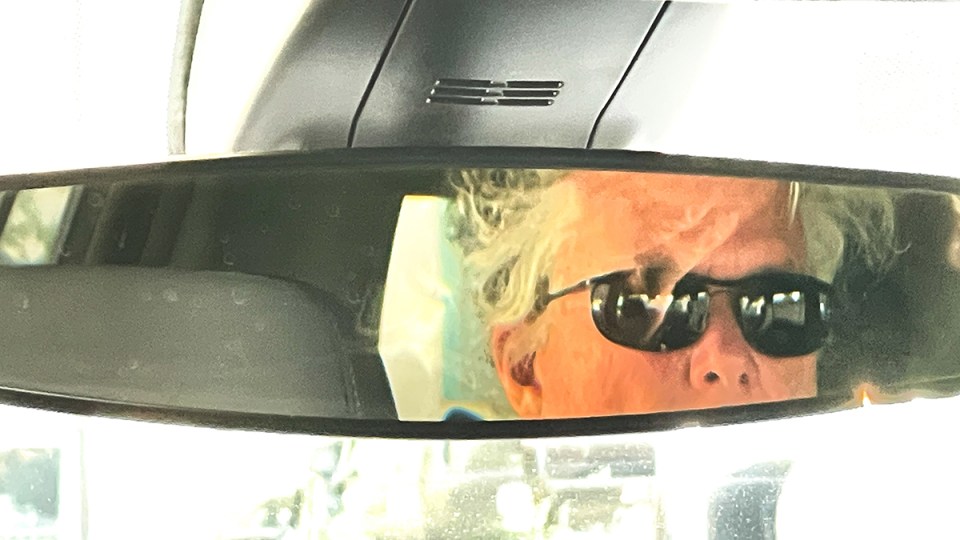
I do get it together, eventually. I slap my sunglasses on and climb behind the wheel, a 6-year old piloting a tank of an SUV through the mountains.

“So, what do you think is happening?” SJ asks after a while. 
“She’s old,” I say, “That’s what’s happening.” I’m a little sharp.
“No,” he says, “I mean with you.”
A pause.
“I’m disappointed in myself. I thought I had a bead on this. All my time with you on the road, all the exposure…I thought I was solid…” I trail off.

“Did I ever tell you the one about tennis?” he asks.

He may have, I think to myself, but I retain less than you’d think after 8 years. “No,” I say. “I don’t think so”

He unspools a line of questions and as he talks I’m wondering what this has to do with anything, but am smart enough to shut up.
“So let’s say you like playing tennis.” 
“Yeah”
“Are you trying to get good at it?”
“Of course.”
“Why?”
“Because I love it.”
As best as I remember he says, “You don’t practice so you can finally stop doing what you love. You get close to the thing over and over again and, if you’re lucky, and if you’re paying attention, you get to chose: who you will be, how you will be, how you’ll proceed, how you will manage one foot in front of the other when the time comes. That’s what grief is. Life bends your knee…” he ends with, another line from The Gloss.

A few more tears gather and spill from behind my shades and I need to feel something other than the neoprene of the steering wheel under my hand. I reach for his hand and I find it. Smooth, a little gnarled and bony, not too far off from my own mother’s. My hand is there for a long moment or two and then back on to the steering wheel. I pack away a future sorrow and set my mind to keeping us safe on the long drive ahead.

It comes to this: You receive some news, you’re far away, and you get to find out a bit about who you really are. The Dark Road gets a little darker and then its one foot in front of the other.

One day at a time, as Mom would say.

Dark Road Diary, Part 53: The Chauffeur, The Nuthatch, and Me

“I was having a coffee and a cigarette one morning. You know…on the porch, feet up in front of me. A bird —a nuthatch, actually— landed on my boot,“ he says over his shoulder to me in the back seat, almost apologizing that he knows what kind of bird it is because he’s ‘into’ birds. 
“I watched the nuthatch try to bury a seed into my laces.”
“That’s beautiful,” I say to the back of his head. He’s in the driver’s seat, navigating thick traffic. It’s early morning, and we are enroute to the airport.

“Yeah…I mean, I don’t want to make it more than —you know— it is.”
“You don’t have to,” I say. “You don’t have to invent the beauty of it. Its’ all there”
He agrees. A little bolder now he says, “That, for me, is my way of being inside the temple.” 

I’m taken aback by his use of the image.

“That’s a genuinely mythical thing, a moment like that,” I say “and you chose to actually see it that way. Not everyone would. Plus, you chose to tell me the story. Now the beauty of that moment belongs to me, too.”

“Oh,” he says “I think anyone would recognize a moment like that.”

“Nah, man.  Maybe everyone could, but clearly not everyone does,” I say gazing out the car window at the 18 through lanes of highway pavement under our wheels and concrete everywhere else. “A moment like that can be a crucible…elementally transforming.”
“Crucible!” he proclaims. “I was just thinking of that word!”

We talk a bit more about books and the traffic, but mostly we let what’s left of the sunrise do the talking for us, and we arrive at the airport a little later. We pull the luggage out and pile it on a cart, and shake hands in a slightly rushed and awkward goodbye, the way strangers might after a sudden intimacy.

“See you again,” I say
“I do hope to meet you again,” he says.

Giving myself over to pushing the top-heavy cart through the airport I wonder, how do I find myself in conversations like this with complete strangers?

(75 minutes earlier)

“I used to live right here,” he says as we pass a little tract of row housing around the corner from where he picked me up. Sometimes I use a car service to get to the airport and this morning’s driver is a little older than me, a little taller than me, and speaks with a pronounced and proper English accent.

“Number 92…yeah. Thirty years ago now…” and then we’re past the place his DNA is all over.

“Is it weird?” I ask. “We just slip by a house you used to live in, no fanfare, no shouts of recognition or welcome back, the bricks and mortar not singing your name and slapping you on the back. It used to be home, now it isn’t. So…transient,” I finish, thinking of all the places I’ve lived. I guess I’m in a chatty mood.

“That word —transient—that really strikes me…” he says. “I’ve always felt like that.”

So it begins.

We haven’t been in the car 3 minutes and we are confessing to each other our life-long challenged sense of home, our divorce from land and place, speaking of it like it was a private, broken part of ourselves. An immigrant from South England, his parents had split when he was young and he and his brother were passed around here and there (a recipe for rootlessness if I ever heard one). He couldn’t wait to escape, and he did at quite a young age, only to be reunited with his brother years later in a small town in Canada. 

“My best, closest friend,” he said. “A talented artist, broke mostly, a real renaissance man.” 

As older men they travelled back to the Old Country and spent time wandering the South Downs , a protected wild area of chalk hills and sweeping fields he and his brother would escape to as youngsters to get away from the dullness of town and the mess of the home front. During the trip they took a photo of a landscape with a solitary windswept tree in it that the brother would later render as an oil painting. 
“He died 5 years after that trip. I took half his ashes back to the South Downs and buried them there at the foot of that tree.”

“I guess that’s home, then.” I say after a bit of quiet.

He speaks of wanting to belong somewhere, and we talk of the ‘longing’ part of that word. 
“I’m not an atheist, I’m not religious, either,” he says, and we agree that he’s simply uncomfortable with the rabid certainty of both camps.
And that’s when the nuthatch appears. 
And that is how the rest of the conversation appears. 

And that’s how this leg of the tour starts.

gh, 

Sept 12, Hinton, Alberta.

Dark Road Diary, Part 47: The Thief With Lightning Fingers

I once stole a photo 
from a widow’s purse.

I was 15, and I was lonely…chronically.

The colour print was that of her daughter,
dressed in a white gown,
maybe at a wedding,
maybe at a convocation.

She was beautiful, and she was my age.
She is my age now.

Her father was a famous author,
and I’d had a sporadic letter-writing back and forth with him.
I met him when I was 12 or so.
He died at 60…just a year older than I am now.
There was a memorial for him in our city,
and this is how I found myself in a room near the widow’s purse.
With the room briefly empty and my breath held,
I lift the photo with lightning fingers and a bolt of guilt.

I taped the picture to my locker at school
and would let the door linger open between classes
in the hope that everyone would think I was claimed by someone.
That’s hope for you.

They lived in Fort Worth, Texas.
This is what I was thinking about, mostly, during our time there.

gh

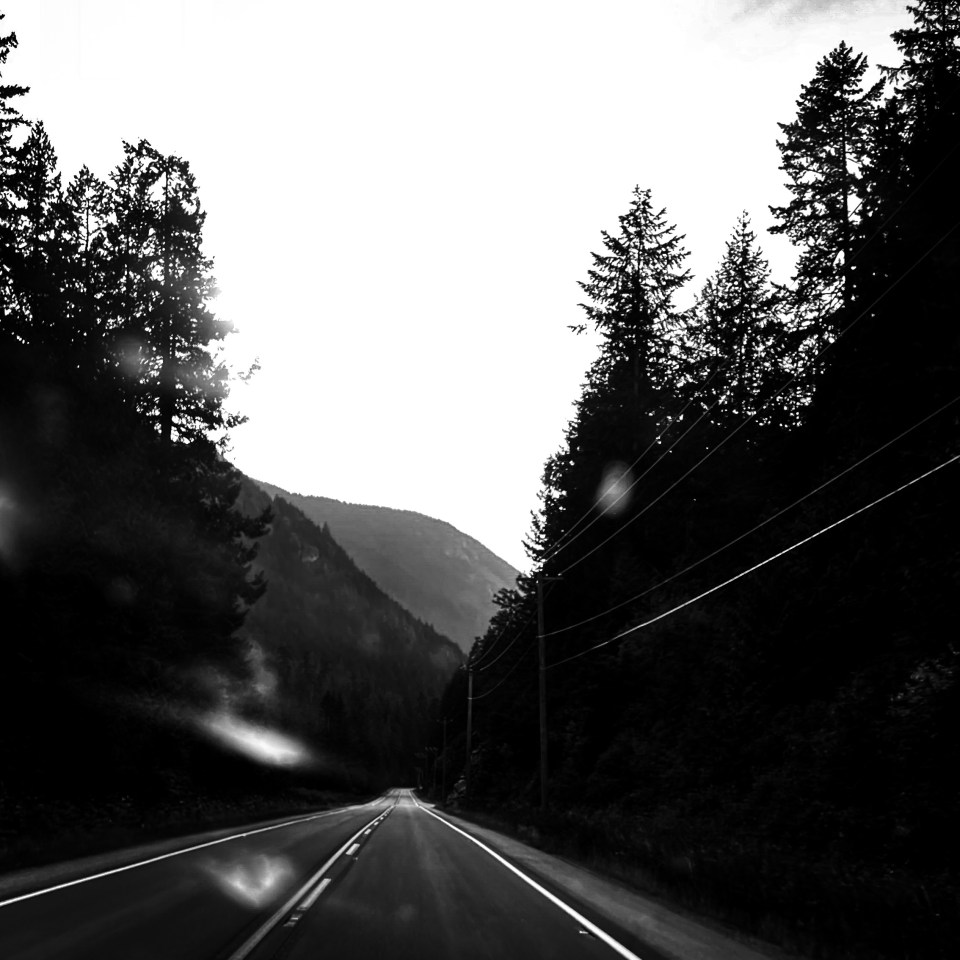
Photo: On the road out of Fort Worth, Texas, July 13, 2023.

Dark Road Diary, Part 46: The Unimaginable Everything

We were, we determined, very different men 8 years ago when we were last in the Austin venue, the town’s first opera hall taken over by the Masons at some point. At the time, our appearance there was the second gig we had played together and we’ve since repeated the climb hundreds of times. It was sold out then, and it was sold out last night, too, thanks to Nathalie and those that put their hand up to bring us back. 

In the green room last night we were trying to find our way to the base of the mountain we had to build then climb. We’ve long since done away with any cocky fist pumping before we go out to the mics, and we’ve also learned not to be undone by nerves…the benefit, I guess, of the aforementioned doing this hundreds of times. But we also know there are no guarantees, so we have to know who we are before we start.  Sounds simple, but you know and I know that kind of knowing is elusive.

In the space of a few private minutes in the green room, we swam silently in the unimaginable everything that had happened to each of us in the last eight years—some of it good, some of it awful. Then the Older Us invited the Younger Us to come out to play because we had to admit: we admired their pluck, their willingness to court the unexpected, their capacity to say “I’m in” to a crazy idea with no possible chance of success.

It was a good move, I think. In the aftermath of the Night, there were so many people who tenderly stood in front of me with soft eyes locked on mine (a gesture I’ve learned to receive with more grace over these last 8 years) and gingerly found their way to not having any words (that tired compliment that can –at times– be such a cop out) and letting some other kind of gratitude fill the space.

The feeling was mutual.  Thank you Austin.  Would that we see you in another eight years.

gh

Photo: The stage at the Scottish Rite Theatre, Austin, Texas, July 11, 2023

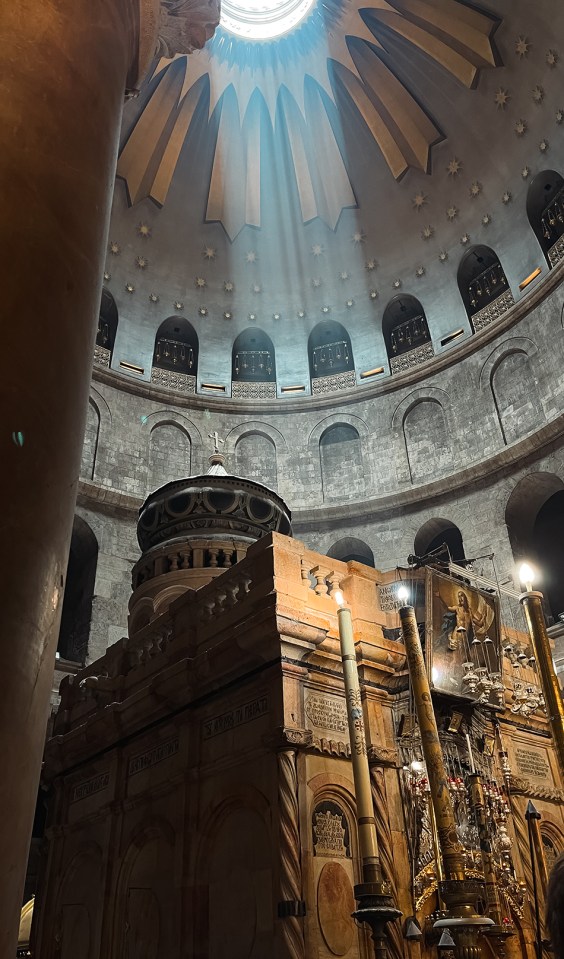
Dark Road Diary: Old City, Jerusalem

So you find yourself alive, born to a particular time, in a particular place, and maybe into a particular tradition. The stories of that tradition weave themselves into your psyche, into the sinew of your world view, and you spend 40 years shadow boxing with something you feel you didn’t choose until you call a truce, make peace, and go back to your corners. You find yourself a further 20 years down the line, standing on ground zero of all that mythology because, chances are, the tradition you inherited didn’t come from the land you were born on, and you find yourself here, almost by accident.

Now, instead of fighting, you are dancing with the weight of it all, because at least you’ve learned that much—dancing with your opponent is more fruitful for the both of you. More graceful. More grace to be had. And you realize tradition is like a song that doesn’t end: you’ll be asked back to the dance floor, and you can accept or decline, and you can take a break if you get tired, and you can love or hate the song. It doesn’t care, and it won’t be offended. It will be the note under everything you do. You’ve come to a mutual understanding.

Because you are born in a particular time, a particular place, and maybe into a particular tradition.

gh

Image taken by the author: Golgotha, where, they say, was the site of many crucifixions, including Christ’s.

Dark Road Diary: Sine Wave

Tel Aviv, Israel.

It shouldn’t have worked.

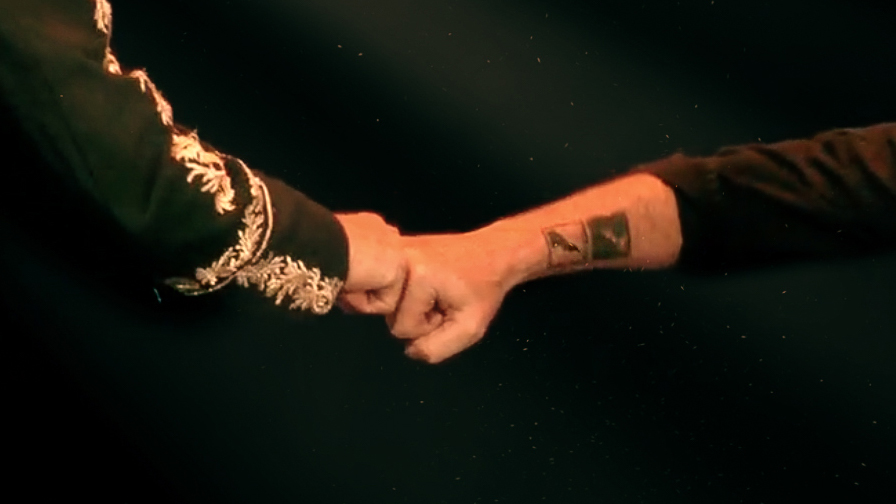
A last-minute venue change the day before the gig to a theatre situated in a movie cinema complex absolutely dressed up like a theme park, complete with life-size characters from the blockbusters of the last 40 years; an unfamiliar format for the evening that included an onstage interview with a prominent broadcaster, followed by a 45-minute set of a Night of Grief and Mystery— a window, open then shut; language barriers; jet lag; and the usual challenges that attend any live event production. Plus, we haven’t been on stage together in 7 months, so it was just a fist bump then “Go!”

It shouldn’t have worked, but it did.


My own understanding of what this thing is that I do with Jenkinson travels along a sine wave: I know what it is, then I don’t know what it is. I’m currently in the “I don’t know” phase. Strangely, it has a calming effect backstage. Fewer expectations, maybe. With room for only one song in the shortened set, we choose a brand new one I’ve never sung all the way through let alone in front of anyone. We decide to forgo a translator or have translated lyrics and text projected beside us, and so there is a gnawing, low-grade worry of not being understood—kind of like, “Is this mic on…?”


Afterwards: private, intimate, mostly silent exchanges with some who have stayed on; gestures in place of words, usually a hand to the heart; long moments of locking eyes; tender hand clasping, the kind that linger softly.

These things are enough for me to know it worked, whatever “it” is. Something worked. And that’s plenty enough to get me to the next gig in Tel Aviv in a few days’ time.

gh

Dark Road Diary, Part 33: John of the Laundromat

John of The Laundromat

It’s hard to know what an audience at A Night is thinking…or feeling. For one, they aren’t really an audience, they’re unintentional allies in a ceremony. They don’t seem to know it, but we do. Beyond the applause and standing O’s, there is the ever foggy sense of “are they with us?” as we spin the kind of glass that we do. No suspension of disbelief is required for this kind of evening. The deal we are trying to make with them is a different one altogether. If there is good will in the building, we can generally pick up on it, but it’s not always clear.

The morning after the Moab Night in front of a full house – which was a free event sponsored by a local hospice organization – I’m doing laundry in the local laundromat. As I finish emptying the dryer, I turn to find an older gentleman a foot away, staring at me.

“I saw you last night,” he says. “It was a wonderful event. I have a few questions for you, if you have the time.”

Always an iffy proposition, and more SJ’s territory than mine, but I’m curious so I figure, what the hell.

“Sure.”

He asks about why we don’t have an intermission, about the set list, a couple other things, and I do my best to answer as I fold my laundry.

Then he asks, “What did you think of the audience?”

That was a stumper. Besides the cell phones going off despite the plea to have them silenced and the full-blown conversation from a deep-voiced individual during the first 10 minutes (dealt with A LOT more grace by SJ than I am capable of), there was the ever present aforementioned foggy sense of just whose side they were on.

I relay this as best as I can, he listens thoughtfully, and almost like a plea he says, “I thought they were with you the whole night, attentive and completely riveted.”

Huh. “Well, I’m glad to hear that,” I manage. He gives me a few tips on what to see around the area before I leave for Colorado (which I took him up on…thanks, John), we say our polite goodbyes and I head out the door into the Moab heat with my folded laundry. 

If you ever find yourself walking a tight rope in front of a crowd that no one has asked you to walk, go to a laundromat the next morning. You might find out how you did. No matter what you thought at the time.

gh
Sept 19, 2022, Boulder, Colorado.

Dark Road Diary, Part 31: Older

I am 53 years old.

Somewhere on the Australian coast in 2017, SJ and I sit watching a group of young people cavorting on the beach we share. I look down at my bloated self and complain about the passage of time, yearning for the form and function of youth.

“That shit is gone,” SJ says, “and it ain’t coming back.” Spoken like a man who knows.

I am 56 years old.

During a 60 Second Answer session I remind SJ of the beach, of the gone-ness of youth.

“What takes its’ place, then?” I ask.

“If you’re lucky, nothing at all,” he tells me. “If you work your ass off, nothing takes its place. It’s a BIG thing in life: Going, going, gone…but not everything goes at once, so you’ve no obligation to scramble to try to reassemble all the parts you started with. You’ve got fewer, you’re lucky. It’s less to carry around. The room for manoeuvering increases the less you’re bound to of the stuff you used to understand yourself to be.”

I am 58 years old.

Every night on stage on this tour is a chance for me to be fully that age, but it’s not granted as a guarantee. Often, the first notes I play are like a key that unlocks the door behind which is every self-immolating thought, every failure I’ve stored away during the run up to the gig, and they pour through. And there I am, taking a public shower under a torrent of insecurity. It’s a precarious moment, and one would think, at my age and with as much time in as I’ve had in the scenario, I’d have a sure fire way of handling it. 

I don’t. I throw myself on the mercy of the moment. Hardly a sure fire way of doing anything, a kind of reactivity of a 15 year old.

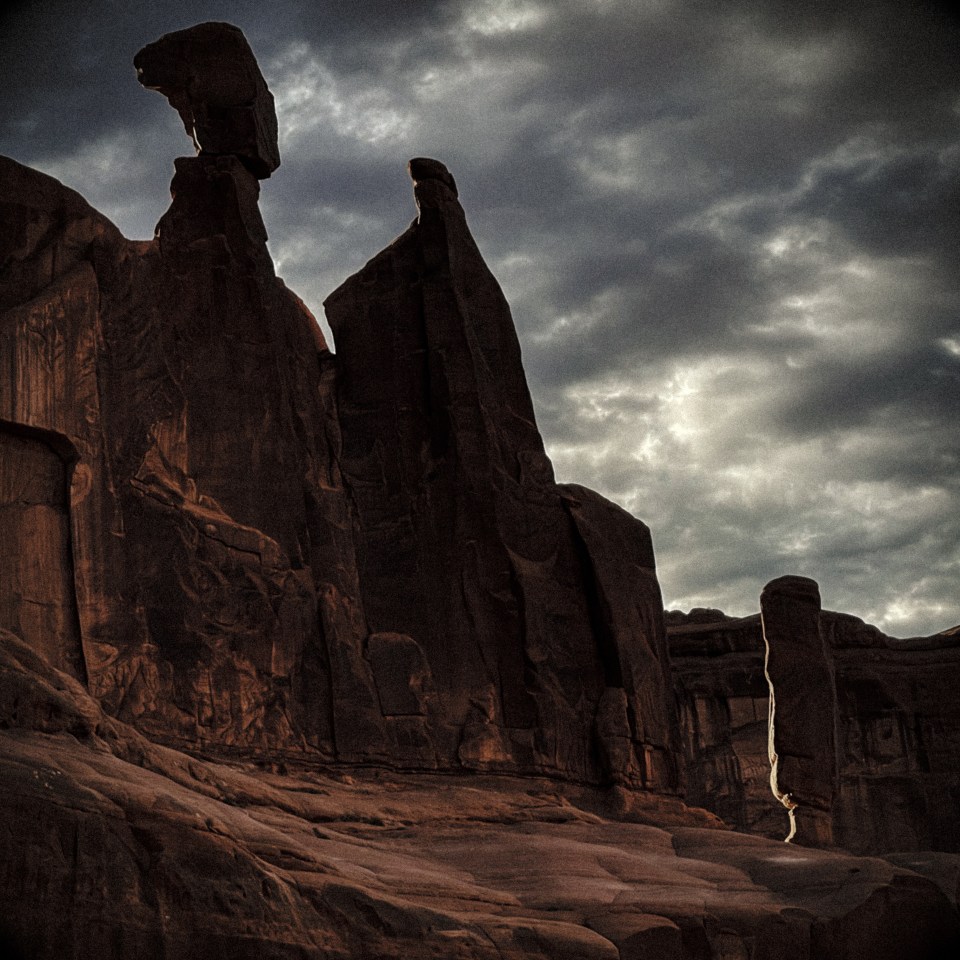
We talk about this on the drive from Salt Lake City to Moab, Utah, where we will play tonight. As we talk, the landscape starts to be accompanied by the red sandstone monoliths the area is renowned for. Older is in the truck with me, and older is surrounding me outside.

Would that I have all I need to remind me to manoeuvre tonight.

gh

Darr Road Diary, Part 32: Plugged Out

The first thing we do after walking on to stage is plug into our in-ears monitors. The price of being able to hear ourselves in glorious clarity is not being able to hear the gathered crowd, or us talking to each other off-mic. By plugging into the system, we unplug from the world. The irony is not lost.

“Blame Bowman,” SJ says.  It’s true…it’s all drummer Adam Bowman’s fault. It was a sure fire way to make the stage experience more musical for us, he said. It cut way down on sound check time, and it meant we didn’t have to carry expensive and heavy wedges around. All true and we are grateful for his expertise.

But the isolation is utterly complete. It’s a weird first move to make on stage. And, as with any added bit of tech, it’s another thing that can go awry, as happened in Boise. Stephen’s in-ears feed completely disappeared somewhere between soundcheck and the downbeat of the Night.

“I’ve got nothing…” Stephen managed to tell me. Under the gaze of the watching crowd, I tried twisting a few virtual knobs and buttons, still nothing. Unable to fix the problem, I basically threw him under the bus. 

“Looks like you’re going old, old school, man,” I said on mic.

And he did, the whole Night long. He rose…he more than rose…to the challenge. As one person wrote in the next day, “Tears filled my eyes many times and overflowed …such an enlightening and soul touching evening…”

Ah, adversity: the faithful companion of every Night.

gh

Photo Credit:

Dark Road Diary, Part 29: Gig Mechanics

Waiting side stage, Smock Alley Theatre, Dublin, Ireland. Photo: Adam Bowman

The arrow doesn’t know
The target or the bow
It’s born in air
Dangerously unaware.

It flies a faithful arc
Through skies light and dark
No promise it finds its’ mark
But it flies anyway.

From “Arrow” ©2022, Gregory Hoskins

Let’s say you have a good notion of what you’re supposed to be doing with your life — some use the term “a calling”, I don’t — and let’s say that you’re lucky enough to have been supported in a myriad of mysterious ways to do that thing. Fine. Now let’s say that because it has the thumbprint of a certain kind of meant-to-be-ness, you find yourself with one foot in the ethereal world of assignment and the other in the more recognizable grind of keeping up your end of the day-to-day deal: a collection indescribable tasks I’ve come to call the Gig Mechanics, the tending to the invisible parts of the machine that allows the Gig to exist.

How you relate to the Gig Mechanics is a choice, somewhat based on your natural inclinations towards detail. Personally, I see it as a dance. Thing is, I’m not a very good dancer. I often end up looking like someone in a dance marathon who has hung in to the bitter end, like a barely-there shell of a person, a ghost leaning on an unfortunate partner. It isn’t pretty.

Get close to someone who is in the thick and thrall of such an endeavour and you are certain to see someone with all the beauty scrubbed away, all the elegance, grace, and assuredness so readily seen from a distance now burned or bleached off of them. Recently, I passed through UK Customs in Heathrow and caught a glimpse of myself in the photo that is snapped as you pass through an e-gate. It was shocking. I looked like I’d been dragged behind the plane across the Atlantic, the toll of the pandemic years’ worth of record making and film making and finally prepping for our tour in the UK and Ireland as the world lurched awkwardly out of plague mode resulting in a mountain of worrying and second-guessing every plan…all of it in plain view in that official photo. I’m not complaining (as my friend SJ says) I’m remembering.

But it was a rewarding tour, by most accounts. No one got Covid; the response from the intrepid folk who helped and /or attended confirmed that there is still a place for something called a Night of Grief & Mystery; and we sold out 8 of our 10 Nights. Mind you, we did those 10 Nights in 11 days, thus this post you are reading. Here are a few things I learned:

  1. 10 gigs in 11 nights isn’t heroic or quixotic. It’s stupid.
  2. Booking a venue based on a picture from the internet is playing sonic russian roulette.
  3. You can lean on people, but lean too hard and they will understandably crack.
  4. Weather systems in a van are like those on the coast: they change every five minutes.
  5. Eating a burger in a gas station parking lot after midnight can be a life affirming thing.
  6. While the previous statement is true, having nutritious food at the gig would be nothing less than an act of love. I seem to have forgotten this.
  7. Sometimes you need to remind yourself that you are part of a ceremony, not a concert performance.
  8. It could be that The Hands that guide these things occasionally see your blind spots and provide a Justin Bonnet (road wrangler) or a Charlie Scaife (sound man) to help smooth the way.

To the band – Lisa Hodgson, Colleen Hodgson, Adam Bowman – and to my compañero SJ, a thousand apologies for the pace, a deep bow for being unwitting but willing partners in the awkward dance with the Gig Mechanics, and a thousand thanks for the glimpse into the possibilities. 

This could be good.

gh

Found Footage is Useful In A War

A few years ago, I got a nice note from a young man who wanted to let me know that, at least for a while, some songs I wrote meant something to him. I’m paraphrasing, of course, but that was the gist. He concluded the letter with “If you ever wanted to fly in a warbird, I’m a pilot, and I fly vintage warbirds and I’d be happy to take you up.” Outside of Star Trek, I’d never heard the word warbird used, it had dangerous overtones and I’m not great with heights, so I politely declined. Then I thought about it: when is an offer like that going to come around again? I told him I’d reconsidered and, on a slightly stormy day at the end of a summer, I rode out there to a hangar that sure enough housed old combat planes. We went up a couple of times in different planes and I took a few videos, paranoid I’d drop my phone. We did one run with a mate of his, part of a team that flew formation drills—that means another plane sharing the sky with you almost close enough that you could jump from one wing to the other. Completely incomprehensible. I survived and managed to keep my diner breakfast down, and am forever grateful for the adventure.

This vid is made from some of that footage, along with a bunch of other video files that have lingered on various drives of mine for years. I enjoy tinkering with movie images, and I make no claim at being any good at it. What I find intriguing is being able to use these moving artifacts of my life as grist for the mill, and in that way, these little vids I have been making are much like the songs I write.

gh

The Wide Shot of Truth

Árneshreppur, Iceland. Photo by Colleen Hodgson

Early on, Stephen described what we did on stage in the US and Australia as “carving in the air”. We’d walk on to a silent stage, just the two of us, with no idea what we’re going to do, so his description of what followed is bang on. We still walk on to silent stages, and I’ve come to describe the current edition of NOGM -— which boasts 7 people on stage— as “sauntering on a tightrope.”

We are always on the tightrope on this tour, and any unbalanced movement feels like jeopardy. I suppose there is a pressure to “know things” on a tour like this. Then again, for most of the last decade I’ve been thinking there comes a time in life that one is invited to plant a flag in what they’ve become certain of, even if it seems dangerous —as it does these days —to know things. If you’ve been lucky enough to have lived a life that has brought you into contact with vulnerability (your own and that of others) then you might not screw this up.

Standing in what you know doesn’t look anything like power. Quite the opposite. It leads to more vulnerability. It can lead to a lot of “not knowing”. That’s why it’s not for the faint of heart.

Or politicians. Or celebrities.

I’m trying to learn to not be faint of heart. Useful in a war and all that.

The wide shot of Truth.

Good thing I’m not alone in the learning.

gh

Back on the dark road to the dark, dark woods.

Friends are forged on the dark road headed out of town, and so we head there again, beginning on June 4, 2019 in Portsmouth, UK.

MAP and thing

A quick note from the factory floor here.

There are a lot of things that slay me about touring with Nights of Grief & Mystery, but few more so than what can land on the table when wrestling with language to properly describe the thing. We seem to be learning about “what this is” as we go along. In the beginning, we were happy to admit that we didn’t know and were more likely to be able to tell you a whole lot of “what it isn’t”. The more we travelled with The Nights, though, the more we understood that simply saying “what it isn’t” was, in fact, a cop-out. Follow?

So here’s our latest understanding:

We have an idea where the monsters are. That’s where we’re headed.

You can read the full new blurb at the new nightsofgriefandmystery.com landing page.

The tour will Take us to 28 cities in the UK and North America for 32…shows?Performances? Nights, is what I prefer to call them.
Or 32 chances to get it right. We know what “it” is.

That dark road thing?
That image is more than an image. That is what we do. That is our devotional act. And those monsters? Probably not what you expecting. That’s another thing that slays me about the Nights: mostly they are everything you wouldn’t expect.

See you out there.

gh

Lingering with Marc Chagall’s Father

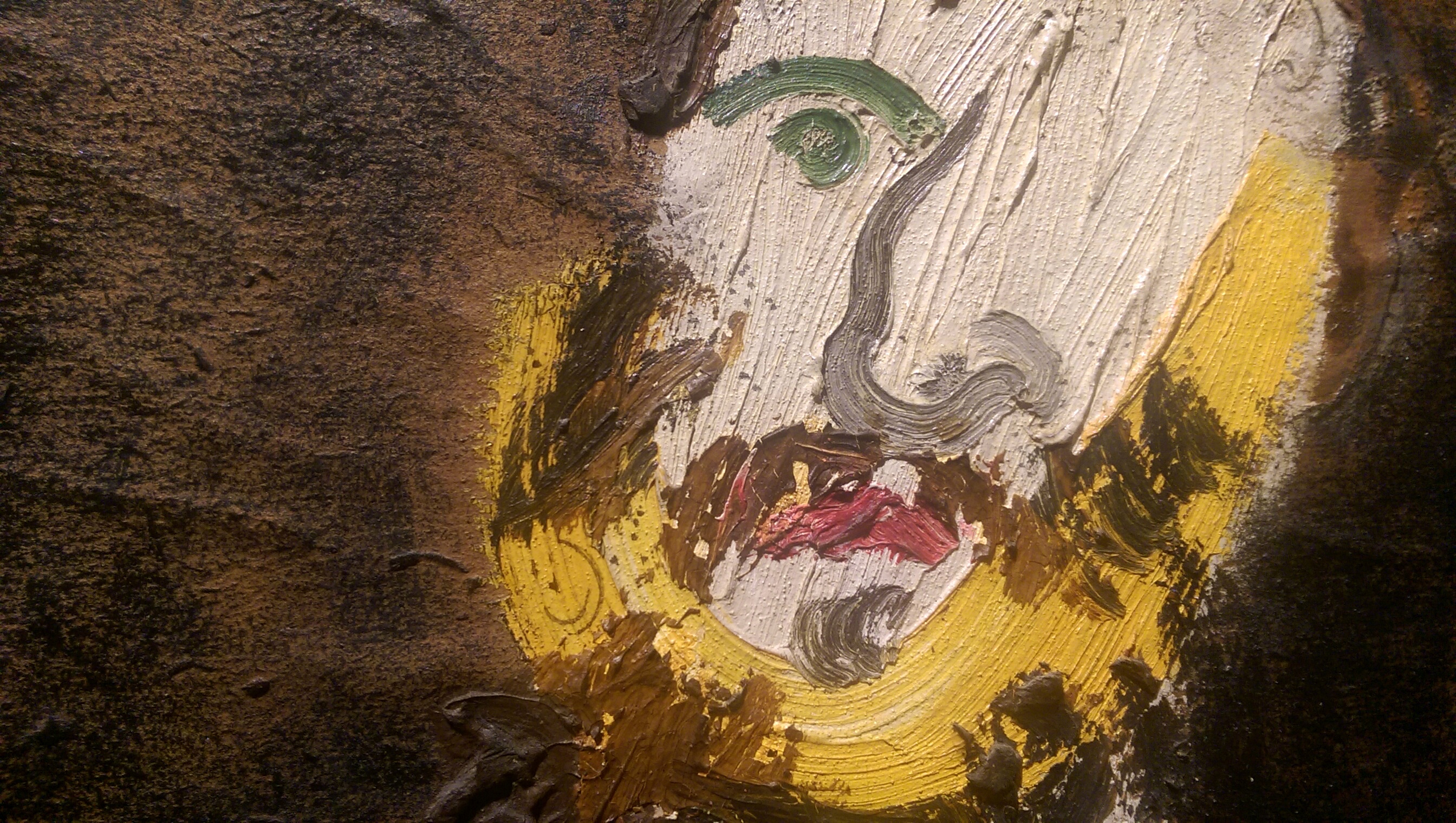
A detail from Father, by Marc Chagall, 1921.

I went to the Louvre once.  It was 1987.  I was 23.  I was on a belated honeymoon trip.  I ate french fries on the patio while playing Crazy Eights, mistakenly sat on a Louis the XIV chair and set off the alarm, and lined up to see the Mona Lisa only to bail on the lineup and take pictures of people looking at the Mona Lisa instead.

I’m not very good in museums.  I become super self-conscious in crowds, and in art galleries I break into a sweat under the pressure of liking what I’m seeing, or the expectation of my having an intelligent opinion because, apparently, it is not enough to like a painting, to be intrigued or moved by it:  you have to know why and be able to tell your mates…and anyone else in earshot…if you talk loud enough.

A couple weeks ago, L & I were in Montreal and took in the Chagall exhibit at the Musee Des Beaux Arts.  It was near the end of the exhibit’s run and the place was packed.  People moved from room to room like sheep and I was a sweaty mess of nerves within a few minutes but I discovered something important:  I enjoy seeing paintings when I can get up close…really up close.  Like sitting in the Louis the XIV chair kind of close.

I found a painting that didn’t have a crowd gathered around it…a portrait Chagall had done of his father (he did a few, I think).  With my nose a few inches away from it, I took my time looking at the canvas without the feeling of 50 pairs of eyes drilling into my back.

ridges

I saw ridges– the pressure exerted, all the places the painter decided to stop moving the brush, the exact moments his brain signaled the muscles in his arm, wrist, and fingers to ease up or bear down or change direction.  Up close, the thing was a study in intention, force, and trust. Micro movements and decisions made on some sub-existent level.  The place where what is invited and what actually appears seem to work it out for the greater good, all caught in oil and pigment a few inches from my nose.  Looking at it like this allowed me to relate to the humanity of the painting, and of the painter.  I appreciated how he painted those he loved, and that he painted himself, too.

I lasted longer than I thought in the gallery, but will confess we did spend a good portion of time in the Kids Chagall Colour Zone playing with puppets.  Well, one puppet.  A donkey puppet.  I loved that puppet.

donkey_small


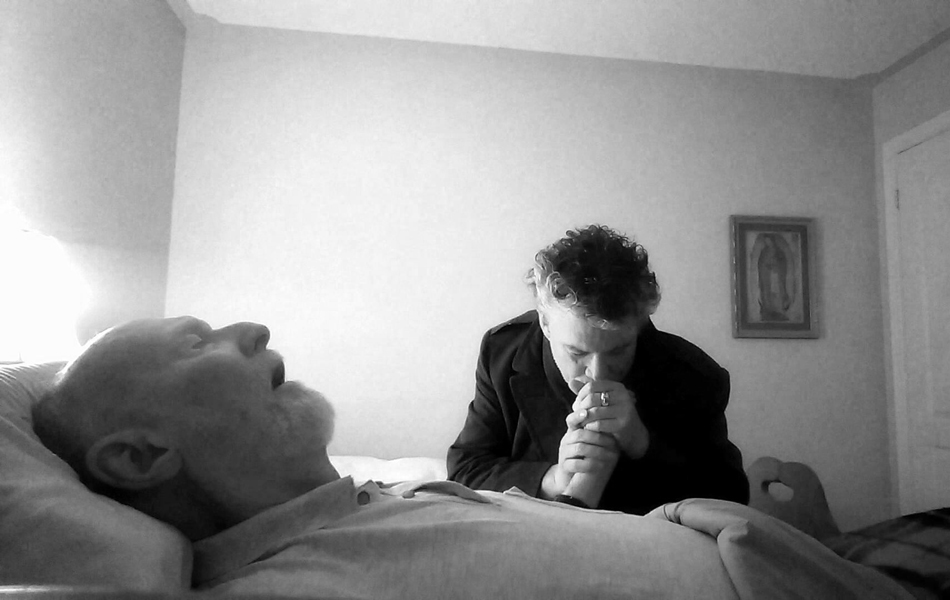
Vain + Alone: The heart broken a thousand times, reassembled a thousand and one.

Vain & Alone, December 25, 2015. Peterborough, Ontario, Canada.


With my father hovering somewhere between worlds, I am firmly Vain but somewhere between Alone and not.

These were days infused with a kind of poetry that crushed us,
days burdened by an unbearable beauty…
that broke the heart a thousand times and reassembled it a thousand and one.
These were days when I was not much of a father to my children,
not much of a lover to my wife, not much of a friend to the few friends I have.
Only a son in service to his father.
In return, he told me with scathing honesty what he saw in me,
and located that nurturing part of me I’d thought long dead.

I’ve held on to this photo for a bit, unsure of it, not trusting its’ origins.
But in the life I have created for myself,
these kind of moments are all I have to weave into the work I do.
So, I wonder aloud here at what this man gave with his dying
to his wife, his children, his grandchildren, and his friends:
shattering the inane noise of the world for us with his ragged breath,
lubricating this arid desert of a place
with tears that leaked from his eyes in his final moments,
and finally binding us together with his absence…

This is the gift he gave us:  how it could be when it is our time to die.

The poetry, the heartache, the laughter, the songs,
the courage, the fear, the healing,
the forgiveness, the goodbye, the wrenching loveliness of it all—
this is what we can give to our own sons and daughters, lovers and friends.

I was alone in the house when I self-consciously set up the phone to capture singing a song to him, a song we had crafted together.  It was a song that came to be when he declared his pride in what I did for a living even though, as a father, it worried him to no end.  He was firm in the pride he felt but asked if I couldn’t at least write something “light”— not my strong suit, to be sure.  So, we spoke of his great love for my mother, and his growing love for the simple beauty he would see outside the window — the trees, the sky, the sun, the birds — that left him speechless and dumbfounded as to why the whole world seemed not to notice.  A song was woven together over time.

On this night, I sang it to him as I had done dozens of times in the previous weeks (along with his favourite cowboy tunes and a few from the hit parade he used to sing to us as kids) but in a self-conscious way, too aware of the camera, wondering what kind of man would film himself like this? as I sang looking down on his unmoving body.

When I stumbled into the bridge,
and the line “Love comes for you”,
he surfaced and opened his eyes to me,
raising his arm slowly to rest his hand on my forearm.
I continued picking through the solo
and at the first line of the last chorus, “Mary, Mary, in the yard”
he chuckled, then slipped back to where he’d come from, gliding out on
“Through the trees the sunlight slips/
To steal a kiss from Mary’s lips.”

This photo, taken after I put the guitar down,
is less a record of my singing to him
and more that of a son who owed his father everything,
learning here how to say goodbye,
and deeper in debt
when all was said and done.

Would that it could be this way for everyone who reads this.

gh